An abandoned apartment in Paris: Alyson Richman’s inspiration for The Velvet Hours
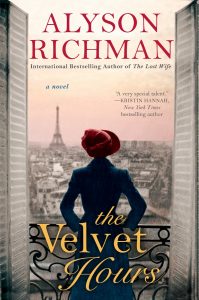 The Velvet Hours by Alyson Richman uses a real-life story of an abandoned apartment as her inspiration. Blending historical fiction within a mystery surrounding the characters’ lives, readers will learn about the Paris setting as well as the time frame from the 1880s through the period just before World War II. Throughout, Richman uses symbolism to enhance the story.
A few years ago an apartment was discovered to have been abandoned for nearly seventy years. It was owned by Marthe de Florian, a little-known courtesan, and inherited by her granddaughter, Solange Beaugiron. Because the facts about these two women are sparse, Richman wrote an imagined tale about them. As with her previous novels she develops a story and answers the mysterious questions of why was it abandoned for seventy years; and what was the importance of the artifacts, including a portrait by the famous artist Giovanni Boldini, which was never listed, exhibited, or published.
In this fictional story, Marthe begins her life in poverty, which springboards her determination to be surrounded by beauty. Her aesthetic looks help her to capture the attention of a wealthy patron, Charles. He sets her up as his mistress, a kept woman, in an apartment where she developed her natural taste and love for splendor. Charles not only encouraged her, but also provided her with the means to survive and sustain herself. He even commissions Boldini to paint a portrait of her to hopefully keep her legacy alive, almost to the point of immortality.
The actual portrait was not found until 2010 when the apartment was discovered. Richman feels the portrait of Marthe de Florian is “sensual, beautiful, and exuberant. There were the beautiful sleeves falling off her shoulder and her skin looked like it was lit from within. The pearl necklace she was wearing around her neck, as with any jewelry, represents a story. I had Charles, her lover and keeper, give her the necklace as a gift of affection, but also for financial security. We learn more about the relationship between the characters by the gifting of certain objects.”
Marthe is based on Richman’s grandmother, to whom she dedicated this book. “When my mother saw the dedication she commented, ‘This way she lives on forever.’ My grandmother was one of the most elegant people I knew. She was a feminine person who took pleasure in surrounding herself with beauty. She actually passed down to me a pearl necklace given to her by a man she once loved deeply, who wasn’t my grandfather. It was incredible how she kept it even though she was happily married to my grandfather for over fifty years. There are pockets of people’s lives we have no idea about. I started thinking how 99 percent of people vanish upon death. Our memories are kept alive through the possessions and the stories told from generation to generation.”

Author photo by Robert Presutti
With the author’s descriptive words the objects seem to come alive and become almost a secondary character. A broken watch given to Charles by Marthe symbolizes how certain objects that are not worth anything monetarily could be priceless to those who own them. Richman explained how this became very symbolic, “The original title of the novel was The Painted Dove, because Marthe was kept hidden by Charles, almost like a bird in a gilded cage. This is why I had her give him that non-working watch with the dove engraved. Charles called her his dove and the watch represents time standing still. I put in the book the writer Jean-Pierre Claris de Florian’s fable because it speaks of their life, ‘the dove hidden safely. Her wings only for me.’ I also wanted to explore the symbolism behind the objects, and how they played a part in the story. Thus, making the story multilayered.”
Velvet was also used to emphasize Marthe’s obsession with beauty. “It is one of the materials that has shadow and light, going from smooth to rough. The metaphor is her illuminating her life as she tells her story to her granddaughter. This is why I put in the quote by Solange about her time spent with her grandmother, ‘Those hours were like velvet to me. Stories spun of silken thread, her own light and darkness, unabashedly drawn.’”
Throughout the novel there is a reference to Asian artifacts, porcelains and Shunga woodblock prints. Being intrigued with the actual pictures of the apartments, Richman wanted to use “a Famille Rose Chinese Vase I saw on the mantle. I am personally fascinated with this period in Paris when the impressionist artists were influenced by the Asian works, including porcelains, prints, and textiles. Marthe self educated herself through these beautiful objects and learned more about their history with the help of Ichiro, the Japanese antique dealer who became her friend. He propelled her to learn more about the culture outside of her own nest.”
One object in particular, the cracked vase she gave to Boldini, represents to Richman “beauty within imperfection. While others might think it damaged, Marthe saw it as something that could be broken and solid at the same time, both co-existing within a life.”
Because the novel takes place in a period just before the onset of World War II, the looming Holocaust plays an important role. She commented “I included an ancient Haggadah, which represents the story of Passover, and the Jewish exodus out of Egypt. I compare that to the threat for Solange and her future fiancé. They used it to help them escape the imminent Nazi occupation as they traveled to America.”
The Velvet Hours places the characters and objects into a fact-filled story filled with symbolism. Richman has created a rich Paris setting with memorable characters within a time period beginning in 1888 and ending in 1938.
About the contributor: Graduating from UCLA with a degree in American history, Elise Cooper has found it fascinating how the past affects the present. She is a historical fiction fan because she likes reading and learning about events, but within a good story instead of a textbook. Her book reviews and author Q&As focus on the history within the story.