A Haunted Past: Simon Tolkien’s Literary Journey
WRITTEN BY KRISTEN MCDERMOTT
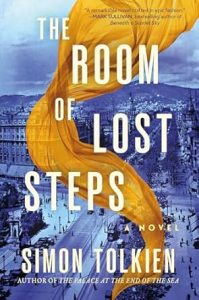 If there’s one author with a personal knowledge of the weight of the past, it’s Simon Tolkien. Reflecting on the journey that has brought him to his latest novel, The Room of Lost Steps (Lake Union, 2025). Tolkien noted that he had already established a career as an author of crime procedurals by the time he made the choice to pivot toward literary historical fiction. “The great joy of my career as a novelist is that I started as someone who needed those props: courtroom drama, which gives you a language and a plot structure. I dropped that, and my characters could live their own lives. I know them, they’re real to me, and that’s what I most wanted to accomplish as a writer: to feel that my characters lived, and lived complicatedly as humans do.”
Tolkien’s The Room of Lost Steps is the second part of a duology that introduces Theo Sterling, born in New York in 1918. In the first volume, The Palace at the End of the Sea, the reader meets Theo as an ordinary eleven-year-old. After his father’s suicide and his mother’s remarriage, Theo must assimilate into a new world of British privilege, but his friendship with Esmond, a charismatic socialist schoolmate, makes Theo dissatisfied with the life his family wants for him. During a summer visit to his stepfather’s orange groves in Andalusia, Theo falls in love with the landscape and people of Spain, especially with Maria, a beautiful young anarchist.
In The Room of Lost Steps, Theo is drawn further into the chaos of the Spanish Civil War by both love and idealism. We experience along with him the 1936 Battle of Barcelona moment-by-moment and share his dismay at the viciousness and death on both sides. Afterwards, he makes the fateful decision to join the International Brigades and learns first-hand what it means to make a choice between personal and political loyalties.
The gorgeously rendered settings for his novel are a mixture of reality and Tolkien’s imagination. His descriptions of the bucolic village of Los Olivos in which Theo experiences Andalusia are mostly invented – such places no longer exist in modern Spain. At the same time, his familiarity with Barcelona, another important setting, was a great help because “the buildings from the 1930s are still there. And as I went down the streets, the history that had become so vivid to me in my reading and research was there but invisible. I felt a little like an archaeologist, depicting a city within a city.”
Following in Theo’s footsteps may remind readers of a similar epic coming-of-age journey written by Simon’s grandfather, J.R.R. Tolkien. Scholars have suggested that The Lord of the Rings is in many ways a World War I novel and that his experiences in that war made the fantasy epic such a powerful testament to resilience. Simon agrees: “It was as if he was narrating a history instead of inventing it, so that the book didn’t seem like fantasy at all.”
But history, not fantasy, is Simon Tolkien’s chosen genre. The title of the novel refers to the setting for Theo’s climactic confrontation with Esmond and with his own complicity in the violence of the war. The room is the centerpiece of a Barcelona landmark, the Palau Güell, designed by Antoni Gaudi in 1886. Tolkien visited the mansion while researching the novel in 2019, alerted by a surviving revolutionary to its use during the Civil War as a prison by the Communist resistance fighters. “I walked through the door and realized that I’d left Barcelona behind,” Tolkien recalls, referring to the fantastical ironwork decor and secret rooms of the palace. One particular room, with a looming coffered ceiling and “snake-like” ornamentation, was used as a waiting room originally, and as an interrogation room by the Communists. The “lost steps” referred to the hopeless pacing of the individual confined to the room awaiting their fate, an experience that Tolkien gives his protagonist at the climax of the novel. “The palace was magical, turned in on itself, alive and watchful, in a way I had never experienced in any building before – and I knew that this was where this book was going to end.”
The haunted room encapsulated everything about the tragic history of Spain for the author, “as if it had been waiting for me all the time.” As he was drafting the novel, “the Russian invasion of Ukraine in 2022 was happening, which felt to me the most enormous moment in history. We had come to assume that [totalitarianism] couldn’t happen again because we were all interconnected, but in fact that’s all an illusion. The same principles during the runup to World War II still apply; it was a rude reminder of global realpolitik.”
The challenge for the historical fiction author, Tolkien believes, is to create a narrative that reminds the reader that all stories are essentially personal ones. Despite the political parallels between the Europe of the 1930s and today, Tolkien notes, “I didn’t write the book in order to comment on the present world, but I do feel there is a strong relation between the two themes: intervention and totalitarianism. However, I’m very distrustful of fiction as vehicle or allegory. The fiction has to exist in its own right; if it’s used as a vehicle for advancing a social or political view, it can’t live.”
Researching and writing this huge story was a seven-year task. The project of creating an intimate portrait of a young man forced to choose between not only different identities but different nations, while at the same time doing justice to the long-lost landscapes and tragic history of Spain, and the incredibly complex political tides of its Civil War, resulted in a 300,000-word epic that Tolkien’s publisher, Amazon/Lake Union, decided must be split into two volumes. Tolkien has nothing but praise for his editors and hopes that his choice to make the shift from the big-name presses that published his earlier work to the more personalized, online model that Amazon represents will bring his novel to more readers than a traditional model in which print books have a limited time to be featured in stores. “I’ve invested all of me in it, it’s everything to me, and you want as many people to share that as you possibly can.”
About the contributor: Kristen McDermott is a Professor of English at Central Michigan University and a reviewer for HNR. Her in-progress novel, Stratford’s Will, was awarded Honorable Mention in the YA and Children’s Fiction category of the 2024 Historical Novel Society First Chapters Competition.
Published in Historical Novels Review | Issue 114 (November 2025)