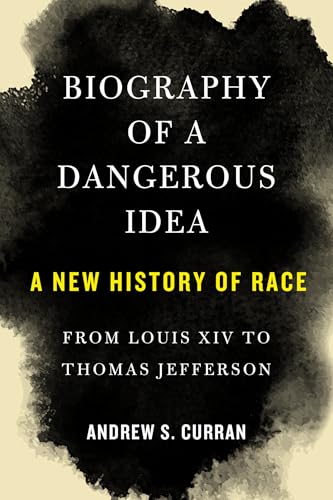
Biography of a Dangerous Idea: A New History of Race from Louis XIV to Thomas Jefferson
Andrew Curran, Professor at Wesleyan University, has published four academic books on the conceptualization of race in the 18th century. This book makes the same ideas more accessible to a general audience: “[while] the concept of race has no biological foundation, its social and political effects are as real and measurable as any other concrete reality.”
The book chronicles how thirteen men, great influencers in their times, struggled to justify categorizing humans in such a way that pedestalized white Europeans (with some exclusions) and relegated Black people to the bottom, just “above” apes. This ordering served as justification for chattel slavery. By focusing on thirteen thinkers, their education, religious views, who they read, who they argued with, and even who they loved, Curran traces how the idea of race was given a biological justification during the Enlightenment. As a counter, he ends with a brief profile of Olaudah Equiano, an example of the many Black writers who wrote about their lived experiences to counter the white philosophers.
Curran starts with Louis XIV, who continued slavery in French colonies to Christianize the Black race. He then traces the race concept in the work of four naturalists, like Carl Linnaeus, who worked to categorize humans in a system with animals while not offending the religious beliefs of their white, Christian readers. There are a prologue and a chapter on Voltaire’s contradictions and overviews of Scottish and German Enlightenment philosophers. The book ends with the brilliant writings and lapses of courage of Thomas Jefferson.
Curran treats each natural philosopher as the hero of his own story, with his own personal issues and pressures from politics and scientific rivals. Each chapter is an enthralling read and leaves us questioning our own assumptions and our place in the thought systems that made chattel slavery possible. Highly recommended.