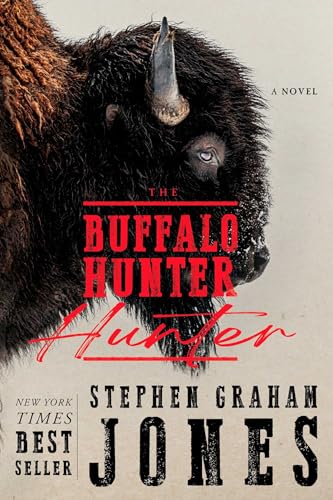
The Buffalo Hunter Hunter
The trail of vengeance for one Native American is a long, bloody, and supernatural one in Stephen Graham Jones’s powerful novel The Buffalo Hunter Hunter.
When a journal written by Lutheran pastor Arthur Beaucarne in 1912 is found inside a wall in 2012, his academic descendant reads through an amazing account. In Beaucarne’s pages, the tale of Good Stab, a black-robed and dark-spectacled man of the Pikuni who appears in the back pew of his Montana church every Sunday, is laid out as a sequential “confession” of the absolution Good Stab may (or may not) seek for his life. Beaucarne, an old man in 1912, “listens with a good heart” to Good Stab’s story every week of forty years prior, when the West was still “wild.” He transcribes Good Stab’s memories of a mysterious “Cat Man” in a cage, something unworldly and impervious to death, that transformed Good Stab into what he claims to be now: “What I am is the Indian who can’t die. I’m the worst dream America ever had.”
Graham Jones casts a spell with this novel that, at its heart, explores the blood-red sins of the White man against the Indigenous, with a ghastly animal-man monster playing the role as avenging angel. The diary-like structure that bounces the viewpoint back and forth between Good Stab and Beaucarne is addictive and secretive, as if one should not be reading it. Beaucarne’s journal entries bring Good Stab’s story of the past alongside the present-day depredations near Miles City of skinned men (or “humps”). He fears he knows the culprit and that he knows too much.
With stylish prose that evokes the linguistic authenticity of Native American culture and the Western frontier, The Buffalo Hunter Hunter is a novel that combines the best of horror and historical fiction. Highly recommended.