Retelling a Mythic Story: Orphia and Eurydicius by Elyse John
 BY KAREN BORDONARO
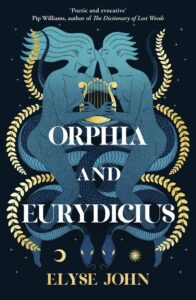
Elyse John is a very gifted writer and poet. Her poetry has been nominated for a Pushcart Prize and has been published in poetry journals appearing in Australia, Japan, and Europe. She now offers the world her latest work, a novel based on a new retelling of the Greek myth of Orpheus and Eurydice (Harper360, 2024).
The traditional telling of the myth of Orpheus and Eurydice features the male bard Orpheus, son of Apollo and the muse Calliope, and the female Eurydice, a woman of beauty and grace, who is bitten by a snake and dies shortly after their wedding. Following her into the underworld, Orpheus uses his heart-wrenching poetry and poignant lyre music to convince Hades, lord of the underworld, to let Eurydice rejoin him in the mortal world of humans. The only catch is that Orpheus is not to turn around and look at her before she is back in the mortal world. Orpheus does look, however, and Eurydice is sent back to the underworld. Orpheus cannot return to the underworld again without suffering death himself in order to rejoin her. He ultimately undergoes this ordeal willingly and reconnects with her there for the rest of eternity.
This mythic love story has found a unique new voice in John’s retelling in which the genders of the main characters are switched.
This approach arose from the death of her brother, whose memory inspires her work. She says she was drawn to this specific myth because, “I would’ve given anything to bring my brother back, and yet I felt his continued presence in my life. She explains that this myth “touched on the outpouring of powerful emotions in grief and the urgent desire to keep the connection with your loved one even after their death.”
The myth of Orpheus and Eurydice further spoke to her because it “spoke to many things that modern society allows little room to discuss and explore” such as death, dying, the afterlife, and ongoing connections with the living.
She further adds that her brother was connected to this myth himself during his lifetime because “[he] also happened to have enjoyed Orpheus’ famous aria in Gluck’s opera and appreciated the lyrics passionately mourning Eurydice.”
John directly acknowledges that “the seeds of this retelling” came from her own bereavement, which in turn led her to “naturally reimagine the story as the tale of a woman mourning a man and seeking to bring him back.” From this beginning came her idea to switch the genders of the main characters.
In retelling this tale with a female Orphia and a male Eurydicius, John wanted to “flip the artist/muse gender binary that has historically dominated storytelling and gallery walls.” She also wanted to investigate “what gender-swapping the characters in a mythic, heroic romance could show and explore about gendered stereotypes and expectations.” As she began to “construct the romantic side” of her retelling, gender-swapping became the element “that came to the fore.”

author Elyse John
John sees our current time as being a cultural moment where female characters are taking on more traditionally male characteristics while the opposite is not always true for male characters. In her retelling, she depicts Orphia as “dazzling a man with her creativity, boldness, and skill,” while portraying Eurydicius as a “gentle, peace-seeking” person who prefers “to be wooed, rather than be the wooer.” She also hopes “that he has a softness to his character which is at odds with the way that masculinity is typically constructed and expressed.” She does note that the “active romancer” and the “receptive beloved” roles aren’t inherently gendered, but that “long cultural patterns of depiction and reception have allowed us to see them as such.” This is this contemporary cultural milieu in which she has written her novel.
Greek mythology seems to have an enduring appeal for readers. John thinks that this appeal may go beyond historical or cultural appreciation. She explains that, “Some readers may find personal connections with this story, which I think is what many of us seek in myth – despite our awareness of cultural and historical aspects of myth, there’s some reason we’re drawn to a particular story over another, or a certain character more than the rest.”
She feels that other connections could come as well from a character exhibiting behaviour that might hold a strong appeal to a reader. Powerful female figures from Greek mythology spoke to her in her childhood, for example, because they held “a great allure for girls who haven’t seen that sort of womanly power in the world around them.”
Current interest in contemporary novels based on Greek mythology is not really a new phenomenon beyond the English-speaking world according to John. She is aware of and familiar with native Greek writers who have been producing novels based on ancient Greek myths during and prior to the 20th century. She feels that their novels deserve to be introduced to English readers just as hers are. Her hopes are that “the literary sphere retains space for newer books in this area – that, rather than treating Greek myth retellings as a short-term phenomenon, publishers will honour their cultural importance and give plenty of space to authors of Greek heritage too, both by picking up new novels and by publishing translations.”
John’s own novel makes use of both poetry and prose. She notes the importance of poetry at both weddings and funerals because it “pierces to the core of our sentiments and helps us to crystallise our feelings.” Poetry also lends itself to works of fiction in her view because “the intense emotional expression in poetry can also help us to embrace moments of emotional depth and richness when writing fiction.”
Prose, similarly, can also draw inspiration from poetry because “the storytelling, character development, and long-form structure of fiction can help poets to find ways to centre character and shape a narrative.” The further value of poetry to prose for her means that “equally, the brevity of most modern poetry can lead a novelist to think about making every word important, or finding a precise image.” She feels that the inclusion of both poetry and prose enriches her work: “I think there’s a beauty in how each form can feed into the other, a mutually nourishing flow.”
Visiting Greece helped John in researching and writing her novel. “I visited sites related to the Orpheus and Eurydice myth while researching the book, which helped me to understand the aesthetics and features of the places I wrote about.”
What she hopes for herself as a writer in the future comes from connections to other writers that she has realized through her own reading experiences. She offers her thoughts about these connections to us in the form of a beautiful image, stating that “When it comes to writers whose work I love, I often find that there’s something about their writing that recurs in their books – however different the theme and story of each novel may be, there’s an element of their art that stretches across their opus, whether it’s a certain stylistic element, a touch of empathy, or a deep-thinking manner of interpreting the world and its problems, like a plant whose roots reach down into lightless layers of soil and draw nourishment from the places that others would conceal. Perhaps that’s the best thing I can hope for as a writer, too.”
About the contributor: Karen Bordonaro writes book reviews for The Historical Novels Review, Library Journal, and The Checkout, and transcribes historical documents for the Library of Congress.