The Emerald Storm – William Dietrich on Ethan Gage’s latest adventure
Jenny Barden

Jenny Barden recently had the privilege of being able to put a few questions to William Dietrich about his writing and his new novel, The Emerald Storm. This is the latest in the series featuring the hugely popular Ethan Gage, lovable rogue and Indiana Jones-style adventurer, chasing villains, women and treasure in the Napoleonic era. Here’s what William Dietrich had to say:
JB: In The Emerald Storm, Ethan is searching for both his son and Aztec treasure amid the first successful slave revolt in the Caribbean. This sounds fascinating, but what made you choose this historical episode as a backdrop, and how did you find out about it? Were there any revelations for you along the way?

WD: The Emerald Storm is the fifth in a series that has followed Ethan in chronological order, so after The Barbary Pirates, my question was, what was happening in 1803? I knew the French army Napoleon hoped to send to Louisiana was destroyed by yellow fever and revolt in Haiti, but the broader story of the first successful slave revolt in history enthralled me. The cruelty required to sustain the sugar islands, and the ferocity of the fight in St. Domingue, was appalling and fascinating. The struggle also seemed to echo today’s debate about income inequality. The poor and oppressed have always been struggling against the rich.
JB: Your novels are set all over the world in some of the most exotic and challenging locations, from Antarctica to Tibet. Much of the action in The Emerald Storm takes place in the Alps, St Domingue (modern-day Haiti) and Martinique. What is it about these places, particularly those in the Caribbean, that moved you to use them as settings for your fiction, and did you encounter any difficulties in doing so?
WD: The Caribbean promised a setting of sultry intrigue, and a more alluring place to do research than Antarctica or Tibet! I also liked how today’s tourist mecca of Antigua was once known as “the graveyard of the Englishman,” showing how much our opinion about the tropics has changed with advances in medicine. So I visited the (very pleasant) islands. However, I was researching not long after the Haitian earthquake and decided I didn’t need to add to the chaos by trying to visit there. Research, old maps, and Google Earth can accomplish a lot when a locale has become a trouble spot. Fortunately, Antigua and Martinique have a lot of information about sugar plantations and slavery. Nice beaches, too.
JB: Ethan Gage is an enthralling character – a jumble of contradictions: both brave and opportunistic, a womaniser and a romantic, a man of action and lazy – you’ve built up a superb backstory for him. But where did Ethan come from? Did you begin with an idea of ‘Ethan in the round’ or has he developed incrementally as you’ve written the books? How much of him is really you?
 WD: On the one hand, Ethan gets to do all the things I don’t and so I live vicariously through his exciting life. On the other, he reflects my journalistic background as a (sometimes wry) observer of the powerful around him. He reflects the 21st Century reader as an ordinary man struggling to swim in the tides of history. He’s buffeted by Napoleon as we’re buffeted by wars and economics; he’s always on the edge of being important and never quite in control of his own life. Instead of steady promotion, his hopes are frequently dashed. Many British fictional heroes of that period are sober military officers who see things strictly from the English point of view, so I thought an American civilian who bounces between France and Britain could be novel and fun. In tone, his comic and rascal side was inspired by George MacDonald Fraser’s Flashman series, though Ethan is a sweetheart compared to Sir Harry.
JB: The Emerald Storm is your fifth Ethan Gage novel, and I’m pleased to learn that you’re under contract with HarperCollins to write two more. Could you say a little about what these novels will be about? What will Ethan do next – and how will he cope with getting older?
WD: In the next book Ethan moves to history’s center stage, embroiled with Napoleon in France in the events leading up to his coronation as emperor. He later meets Nelson (and Emma) before the book climaxes at the Battle of Trafalgar. Being Ethan, he’ll be caught seeing things from the French and Spanish side and believe me, Nelson is terrifying when you’re on the other side of the cannon muzzle. He was a feisty little bugger. It requires a cat’s cradle of plotting to move Ethan from Point A to Point Z in this very complex tale. My intention is then to follow England’s greatest naval victory with Bonaparte’s greatest land victory in Book 6, at Austerlitz in today’s Czech Republic. There’s a quest in central Europe that will embroil Gage and his family.
 JB: After your last Ethan Gage novel, The Barbary Pirates, you didn’t immediately follow on with another in the series, but instead wrote Blood of the Reich, a thriller based on a Nazi expedition to Tibet and a contemporary conspiracy in Seattle which reaches its climax at the CERN supercollider outside Geneva. What prompted you to switch – and do you have any other stories taking root which might appear in the future alongside more Ethan Gage adventures?
WD: I was interested in taking a break from the series and my publisher thought something different might introduce me to new readers. My first novel, Ice Reich,was based on a real-life Nazi expedition to Antarctica, and when I stumbled across a real-life one to Tibet as well, I was intrigued. Those Nazis got around! The challenge for me was to weave a contemporary thriller into 1938 events, have a young woman instead of a man as my primary character, and cap it with particle physics. It was great fun to write but challenging to construct. Tibet was one of the more interesting places I’ve traveled to for research, and the religious society there reminded me that for much of human history, people have lived very different lives than we do in our secular, materialistic West. I tell students to challenge their own assumptions, because travel always challenges mine.
JB: You’ve had a brilliant career in a number of fields; as well as being a NY Times bestselling author, you’re a Pulitzer prize-winning journalist, a researcher and academic, and an acclaimed author of non-fiction work on environmental subjects. How has this breadth of experience informed your fiction? You clearly have a love of the remote wilderness areas of the world – it’s one that I share – are there any insights that you bring to your novels which have come from this affinity and your background, for example regarding the bearing that geographical terrain has had on historical events?
WD: I grew up and live in the Pacific Northwest, which is a spectacularly beautiful region, and that sense of landscape has infused by non-fiction and fiction, from environmental journalism to putting my books in exotic settings. I think environment influences human character and history, and that the preservation of dramatic places is every bit as important (though not more important) as the construction of great cathedrals or museums. All literary characters are struggling to understand their place in the universe, and sometimes moving them from the drawing room to the wilderness clarifies that understanding. Harsh and exotic landscapes are also useful to test a hero’s mettle. My novels also contain a lot of information and historical trivia, and that comes from my research work as a journalist. I like learning oddball stuff.
JB: Have there been any pivotal moments that have influenced the course of your novel writing, or any particularly memorable incidents en route? What has most thrilled and inspired you – and have there been any episodes that you’d rather forget?
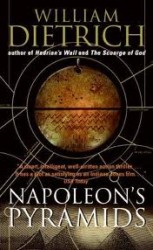
 WD: I stalled on the writing of my first novel until I had an opportunity to return to Antarctica on an icebreaker and saw my first icebergs; I finished a (very) rough draft on that ship. One of my peculiar experiences occurred when writing Hadrian’s Wall, a novel set in Roman Britain. Our travel schedule put my wife and I at the Wall at the height of a hoof and mouth epidemic, when much of its length was off-limits. Dang! But the result was a deserted landscape, bitter March snow flurries, and columns of smoke rising everywhere from pyres of slaughtered and burned animals. That was more atmosphere than I had counted on, and the pall perfectly fit the mood of a novel set near the end of the empire. It showed how serendipity is constantly at work in the development of novels. I was with a group that got to spend a couple hours alone in the very spooky Great Pyramid where I lay in the sarcophagus and incorporated that mood of mystery into Napoleon’s Pyramids. For Blood of the Reich, a Himalaya squall drove me into a Tibetan nunnery for refuge, which inspired scenes in that tale. Stories are organic, growing out of an author’s life.
JB: As a writer myself, I’m really interested to know how you go about your work as a novelist. You obviously write quickly – you have fifteen books to your credit along with countless papers, articles and features, and over the past few years you’ve written a novel a year on top of your academic work. How do you mange this? I imagine you must be very disciplined about your writing. Do you plot carefully and structure each writing day, or are you more impulsive?
 WD: I’m pretty methodical, and a career as a newspaper journalist accustomed me to writing quickly and meeting deadlines. After too many writerly dead-ends in the first couple of novels that required a lot of backing and filling, I outline now. While the stories evolve from that outline, I have a pretty good idea where I’m going. I also treat it as a very unromantic job, plopping down after breakfast to write almost every day. Inspiration still comes, but I can’t always wait for it. I feel so fortunate to have this job that the least I can do is keep plugging. Getting paid to rummage in the past and dine with Jefferson and Bonaparte? Outrageous!
JB: How optimistic are you for the future of historical fiction in general and historical adventure thrillers in particular given the growth of ebooks and the changes engulfing the publishing industry? Is Ethan Gage at all daunted by what’s happening?
WD: One of the running jokes of the series is Ethan’s comment on “modern times” and his frequently wayward predictions of the future from his vantage point of 1803 or so. Nobody knows what’s coming. I think the consumer appetite for good stories and useful information will be stronger than ever, but the traditional paper novel will be supplemented by new forms of electronic writing that are still being invented. The “book” has been defined by the practicalities of printing, weight, and shipping, but now those boundaries have disappeared. Maybe a story can be 10,000 words instead of 100,000, and maybe it can be a million! Historical fiction could be supplemented by illustrations, portraits, details of everyday life, and travelogues of the places being written about. Maybe oral storytelling will make a comeback, with the more attractive and actorly authors reciting their work in a future version ofYouTube. Maybe the Dickens serial will reappear, with future authors posting each chapter as it’s written. For this geezer, I’m most comfortable in the traditional book world I grew up with. My own plan is to write what I can and expire.
JB: Do you have any top tips or recommendations for HF enthusiasts – and is there any parting message you’d like to give?
WD: The past is so prim and sanitized in our schools. I wish history was taught to the young as what it really is, an always arguable story about people who are lusty, greedy, yearning, curious, ambitious, idealistic, cynical, romantic, stupid, vain, and so on. Too many kids are turned off by the stiff caricatures we teach and so they graduate not really liking history and not being a potential audience for the historical novel. One way to remedy this would be to use more historical fiction in the classroom. I remember my grade school exposure to the novel Johnny Tremain, about the American Revolution, was much better than the high school textbooks on the same subject. I think HF enthusiasts are heroic for keeping interest in history alive. Our nations are still repeating the past because we don’t learn from it, and for evidence of that just look at Iraq and Afghanistan.
 My grateful thanks to William Dietrich for his wit and wisdom as well as the fabulous Ethan Gage.
The Emerald Storm is released on May 8.
Interview by Jenny Barden whose debut Mistress of the Sea will be published by Ebury Press, Random House, in September 2012.
Jenny is the Co-ordinator for the HNS London Conference 29-30 September 2012