Snarling back to life: Bernard Cornwell on Pagan Lord, Uhtred’s latest blood-drenched outing
Terri-Lea Laurie
 TLL: I would like to kick off this interview by getting your thoughts on genre reach. I have noticed that the Warrior Chronicles/Saxon Stories can be a bridge across to the fantasy genre reader. I believe Steven Pressfield’s Gates of Fire is the only other book that can do this as successfully as your Uhtred series. What is it about your version of Ninth Century Britain and your characters that appeals to the fantasy reader and not just the historical fiction reader?
BC: I don’t know the answer to that, so all I can suggest is that fantasy readers like lots of swords and sorcery! Uhtred certainly provides plenty of swords, but sorcery is in fairly short supply. I’m not sure where fantasy ends and science-fiction begins, but maybe the cut-off point has something to do with weaponry? I’m not a reader of fantasy novels, so I’m no expert, but my impression is that readers want a world of heroics and there’s no doubt that Anglo-Saxon Britain provides that. I’m guessing that Tolkien is responsible for the fantasy-enthusiasm, and it’s surely no coincidence that his area of academic expertise was Anglo-Saxon Britain.
TLL: Something I have always wanted to ask. How was the uniqueness of Uhtred of Bebbanburg created? Was he inspired at the outset by a real life person or a side of your own personality? Or is he born solely from fiction? A raw and complex man for a raw and complex time.
 BC: There really isn’t a conscious moment of creation; if there was I could give you a proper answer. I’d long wanted to write a series about the making of England, a topic on which the English are amazingly ignorant (myself included), but beyond knowing that it had to involve King Alfred and his offspring I didn’t have much else in mind. Then I met my real father (I was brought up as an adoptee) and discovered his family tree went back to the Saxon invasion of Britain and, notably, contained the many Uhtreds who ruled at Bebbanburg; the family name is now Oughtred, so the descent was very direct. What puzzled me was how the family kept hold of Bebbanburg right through the period of Danish domination, and that was the real genesis of the story and of the character. But that said I just let him develop as the tale went along, which is my usual way of working.
TLL: When you sit down to write a book in the Warrior Chronicles, do you have to revisit any UK settings in the flesh? Do you need to stand beneath the walls of the real Bamburgh (or similarly sited structure) to reignite that drive Uhtred has to take back his ancestral right?
 BC: I certainly don’t need to reignite Uhtred! He has enough drive already. I just let him out of his box. And yes, I do visit the places that feature heavily in the stories – I do that for just about every book. I call it ‘research’, but really it’s a pleasure!
TLL: Who was Bernard Cornwell when you wrote The Last Kingdom compared to who you are now with The Pagan Lord? Do you feel you can still tap into the person you were when you started the series to keep the world and characters consistent? Or is it a process to find him again?
 BC: I don’t feel any different! Uhtred has changed a little, but that’s to be expected as he gets older. And there’s really no process to find him again – he comes snarling back to life every time!
TLL: There are strong themes of religious tug-o-war in your Saxon books. What are your personal thoughts on why Christianity was so easily embraced by Pagan cultures in Britain? Why did a people whose spirituality was so connected to the land and the elements give up that connection (and protection) for this ‘new’ God?
BC: I’m not sure the process was that easy, and pagan superstitions lingered on for centuries. In almost every case the conversion was top down; the missionaries converted the ruler and he forced it on his people. I suppose the crucial difference is that Christianity offered an afterlife. So, of course, did the religion of Odin and Thor, but that afterlife was really only for the warrior class while Christianity’s heaven was for everyone and that had a much greater appeal to women, and women are the real transmitters of culture (they raise the infants). The pagan religions tend to be very male oriented. Then there’s the exclusivity of Christianity; it doesn’t tolerate other religions. Most pagan religions were tolerant; they accepted that there were many gods and goddesses and didn’t persecute people for believing in those other deities, but Christianity wouldn’t abide competition and was savage in its intolerance. Religion, at heart, is simply an attempt to answer the unanswerable questions (why did the harvest fail, why did my child die, why why why?) and paganism tended to fatalism (it just happened, live with it), but Christianity offered the solace of recompense; your child might have died, but you’ll be reunited in the afterlife.
 TLL: Is there any particular story within the sagas and Norse culture that has been a source of inspiration or contemplation for you and if so, why?
BC: The biggest influence is Old English poetry, of which we have a lot. Why? Because it’s a glimpse into how they thought.
TLL: I know every author of a series gets asked this, but I also know readers will want me to ask it. Have you any plans to wind up the Uhtred story in the near future?
BC: No!
TLL: Are there any authors/books, past or present, that you recommend to people who particularly love the Saxon and Norse theme of your Warrior Chronicles?
BC: I’d recommend The Hammer and the Cross by Robert Ferguson and Michael Wood’s King Alfred and the Anglo Saxons.
TLL: What do you make of social media’s role in reaching new readers or in reaching the next generation of historical fiction readers? Should authors embrace it do you think? Or are you still undecided?
BC: I have no idea how effective it is, but it has to be embraced!
TLL: In closing I would like to ask a question tailored to any reader who has given you feedback or one day hopes to. After all the years and all the books, can you still be surprised and learn from reader feedback? Also, as a result of feedback, do you find yourself perhaps evolving your style to accommodate social changes within the readership?
BC: I don’t think the style changes, but certainly the themes do. I do listen, and I learn, and yes, I can be surprised by comments.
Terri-Lea Laurie blogs from Ancient and Medieval Mayhem and runs the Goodreads group Ancient and Medieval Historical Fiction.
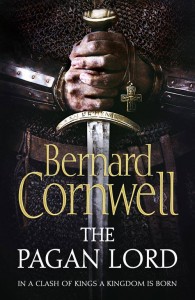
Bernard Cornwell’s latest novel, The Pagan Lord, is released in the UK on 26th September. Read an exclusive extract here.