Douglas Jackson speaks with Tim Hodkinson about the inspiration of Rome
Tim Hodkinson
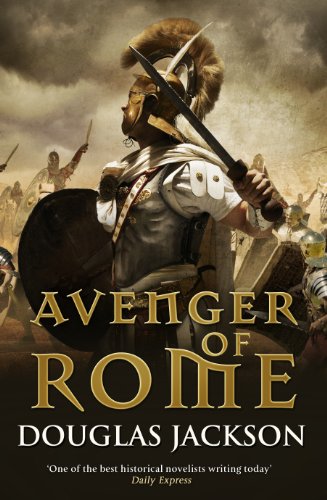
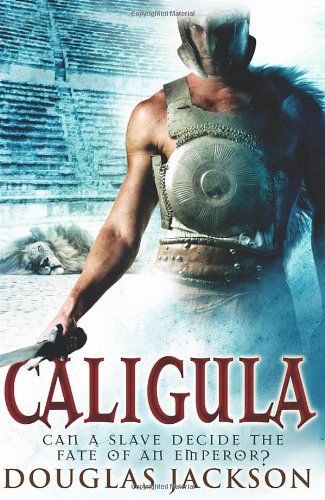
 Billy Connolly once commented about the Scottish soldier: “People have this notion of the romantic Highlander….but most of the fighting was done by wee men from the Borders called Armstrong.” Douglas Jackson is not “wee” but he has the stocky build and close cropped hair of an ex-squaddie or perhaps a wing forward for one of the border rugby clubs. It was in the world of journalism however that Douglas Jackson began his career in writing, spending 36 years working on local and national newspapers and finally ending up as assistant editor of The Scotsman. Since moving into full time writing he has written both historical novels and contemporary thrillers. Writing as Douglas Jackson he published Caligula and Claudius covering the exploits of Rufus, a slave turned animal trainer as he tries to survive the brutal and complex politics and warfare during the reign of the two Emperors the books are named after. Still in ancient Rome and moving to the reign of the Emperor Nero, he has published an on-going series of books outlining the career of Gaius Valerius Verrens: Hero of Rome, Defender of Rome and Avenger of Rome. Not content with historical fiction, he also branched out into contemporary thrillers and released The Doomsday Testament and The Isis Covenant under the name of James Douglas. While based largely in the modern period, these still have a historical theme to them.
When I met him at the London conference of the Historical Novel Society in September of 2012 he was co-chairing an extremely entertaining and informative workshop with Angus Donald, Bernard Cornwell and Russell Whitfield on how to make fight scenes convincing. I thought that might be as good a starter as any for the interview:
TH: Your books contain vivid battle scenes. Do you like writing them and how do you make them convincing? Have you any specific experiences in this area?
 DJ: I suppose it’s being brought up in the early 60s, which looking back now, is very close to the war, but I’ve been interested in warfare and battles as long as I remember. My great grandad fought in the Boer War, my grandad was at Gallipoli and my dad served in the Malayan Emergency. The first pictures I have are of me on holiday down in Leicester, with my older cousin’s toy gun and helmet. He collected memorabilia and he’d send me anything he tired of. When I got a little older my pals and I would play British and Jerries to all hours of the night. Later in life I devoured books about battles and soldiers and it didn’t matter whether it was about generals or the squaddie on the front line. I think that gave me a well rounded view of what it’s like to be a soldier; the hardships of those who do the fighting and the strategic vision required by the top brass. It was wonderful to discover that I was able to translate that to the page. One of the finest compliments I had recently was from an American soldier who said he could relate to everything I wrote. I had a wonderful time writing the battle scenes in Avenger of Rome from scratch, and trying to work out a way for 20,000 Romans to thwart the might of Parthia with its swarms of mounted archers and armoured cavalry.
TH: An interview you did with The Scotsman suggests you just suddenly decided one day to write fiction while listening to an audiobook. Is this true?
DJ: My friend Nicola Barry, who was on the Glasgow University M.Litt course at the time, took me out to lunch on one rare occasion while I was at The Scotsman. We were chatting about books and writing and she said: ‘You should write a book Doug, I bet it would be really gritty.’ I decided there and then that it was time I did. Like all journalists I’d harboured ambitions of writing a book, but as a family man working full time there’d just never been the opportunity. This time I made the opportunity. I decided I couldn’t ‘write what you know’ and the only alternative seemed to be ‘write what you love’ which was history. By coincidence I was listening to Simon Schama’s A History of Britain and it mentioned the Emperor Claudius parading on an elephant at the surrender of Britain. That became Caligula, Claudius and the spark for Hero of Rome.
TH: Why did you decide to begin writing tales set in the Roman Empire?
 DJ: See above. People talk now about a Roman bandwagon, but at the time the only authors I’d heard of writing about Rome were Conn Iggulden and Lindsey Davis. It could have been any other period of history. I’m proud to be part of a posse that now contains Ben Kane, Tony Riches, Ruth Downie, Harry Sidebottom, Simon Scarrow, Henry Venmore-Reynolds, Russ Whitfield, Simon Turney, Gordon Doherty and Robert Fabbri. We call ourselves JAFRAs, just don’t ask what the F stands for.
TH: The hero of one of your series, G. Valerius Verens seems like a basically decent, brave individual trying to do his best while working amid a regime that is corrupt and dangerous. If that correct, is that your opinion of Rome and its Empire?
DJ: I think you only have to look at the casualty list to answer that question. When I was writing about Caligula I was astonished at the number of people he disposed of and the novel and horrific means he found of doing it. You could argue that the brutality was dictated by the man at the top, but the Emperors always seem to have found plenty of people to do their dirty work for them. There’s also the fact that Claudius, generally regarded as an amiable old soul, seems to have got rid of almost as many enemies as Caligula, helped by his freedman Narcissus, who gets a rather flattering portrayal in my first two books.
TH: What made you decide to branch out into writing contemporary thrillers?
 DJ: I got into it by mistake. Not a lot of people know this, as Michael Caine once said, but at the lower end of the writing scale it is difficult to make a living. I always knew I’d have to write two books a year to keep our heads above water. I pitched an idea to Transworld for another historical series to run parallel with my Roman books. Unfortunately, that handsome bounder Giles Kristian had gone in the week before with exactly the same idea, which is now his excellent Bleeding Land series. Instead, my editor asked me if I fancied a crack at a thriller. My first thought was, no. But then the ideas started to come and I thought this could be fun, and anyway, there are only so many ways you can kill someone with a sword. The result was Doomsday and Isis, soon to be followed by The Excalibur Codex and The Yamamoto Exchange.
TH: Is it fair to say that your modern thrillers still have a “historical bent” to them? If so, can you tell us more about that?
DJ: It is fair, and that’s always the way I intended it to be. My first idea was for The Isis Covenant, and the genesis was the expedition Nero sent to find the mystical Treasure of Queen Dido. What if the centurion in charge actually did find it and it contained this monstrous evil that would haunt the earth for the next two thousand years? I’ve always had an interest in World War Two, so I combined my two great loves. You can’t really go wrong when the last siting of a bloodstained Egyptian artefact was in Hitler’s Bunker in late April 1945.
TH: Why did you choose to release your thrillers under the name James Douglas, and how did you come to choose that name?
DJ: It’s very simple. My given name is James Douglas Jackson. I’d have been happy for the thrillers to be published as Douglas Jackson. It was the publisher’s decision to give me a new identity.
TH: The Daily Express described you as “one of the best historical novelists writing today” – what do you think makes a good historical fiction novel?
 DJ: And very flattered I was too. I think it’s the ability to combine an enthralling and convincing sense of place and time – evoking the sights, sounds and smells of an era – with a wonderful adventure, romance or even crime story. Good research is essential and a compulsion towards authenticity (though who’s to say what’s truly authentic), but once you have your world don’t weigh it down with more detail than you need just because you know it. When I started out I wanted someone to say: ‘He puts flesh and blood on the dry bones of history and breathes new life into them.’ I’m still waiting, but that in one way or the other that has to be every historical novelist’s ambition.
TH: What are your thoughts on the current state of Historical Fiction? Are there “too many books about Rome” for example?
DJ: I think it’s astonishingly vibrant and I’m hugely proud to be a part of it. There are just so many talented writers, covering just about every era of history from so many different and fascinating angles, our readers are spoiled for choice. I can see why someone would say ‘too many books about Rome’ but if you look at the ones out there and the reviews they get, they’re all different and the quality of writing and ideas is staggering. You can dip your toe in any period of Roman history over about seven hundred years and you’ll land on a potential book.
TH: Are there any other periods of history that interest you and when you could you see yourself setting future books?
 DJ: I’m interested in all periods of history from the Iron Age to the Second World War. To my eternal shame, mainly the bits where people are trying to kill each other, but let’s face it that’s most of it. I potentially have another five or six Roman books to write just to finish off the stories I have in my head about the period, but I’ve been pondering where next for a couple of years. It’s very difficult to find something different. The English Civil War seemed a good call, but I found out that Mike Arnold was doing a series, then Giles got in on the act and Lindsey Davis published a book on the period. Medieval times are close to my heart, but very crowded. I considered doing a book about a Scottish mercenary fighting with Napoleon, who rises through the ranks to high office, but I’m not sure about the commercial prospects.
TH: Is it hard to write novels set in time periods separated by 2 millennia?
DJ: Not at all. I find it very refreshing. Both of them have their guilty pleasures. In a contemporary novel you don’t have to worry if the third temple on the right was built in AD 56 or AD 58, in a Roman one the world is so fascinating you can just wander around without boring anyone. One of the nice things when I started writing was that I found I could dip in and out of a book and jump to a different subject more or less at will.
TH: As a Scot, have you any plans to write about Scottish history?
DJ: I’d love to, but I don’t know when. The last Valerius novel will be set back in Britain and end somewhere about Mons Graupius. It will take me full circle, because I’ll be able to use ‘My father was a great man. He tamed the wild beasts and made them do his bidding.’ which was the opening line of what was then The Emperor’s Elephant. It had to go when I realised I’d have to change points of view from the father to the son somewhere in the middle of the book, but Rufus’s son Gaius, who’ll be about 45, will be a guide for Agricola’s troops and regale them with talk of his father round the campfire. I also have plans for a series based on the lives of Scots kings who met sorry ends, which is most of them.
TH: Who or what inspires you personally (either as a writer or in the real world)?
DJ: Several things: In the writing world it would be John le Carre, who weaves spell-binding prose and creates wonderful characters, and makes it all look so easy. In life it used to be fear of failure – if you can call that an inspiration – but now I’m just inspired by being a writer and being allowed to create all these wonderful characters and tell their stories. I’m also inspired by my family, who’ve been incredible in their support of me. I promised them that their lifestyles wouldn’t suffer when I left The Scotsman and I’ve battled to live up to that over-optimistic pledge ever since.
TH: Which authors and genres do you enjoy reading?
DJ: I don’t read as much fiction now as I used to, but I still love HistFic with a passion. I’ve read and re-read CS Forester, Patrick O’Brian and Bernard Cornwell. Adventure novels by Wilbur Smith and Alistair McLean. Spy novels: Alan Furst is a brilliantly evocative writer and I’ve a more or less full set of John le Carre books. Anything by Martin Cruz Smith or Michael Connelly.
TH: What are you working on at the minute?
DJ: I’m whiling away the days until the main edit of Sword of Rome, the next Valerius adventure, comes through, by rewriting a particularly brilliant crime novel (set in Scotland) that has yet to find a publisher (hint).
TH: Do you have an iPod? If so, what’s usually playing on it?
I do, but I found that it was making my ears whistle – not in a nice way – I listen to music on the computer, mainly anything from the Seventies and Eighties or with a twangy guitar riff.
TH: What do you do apart from writing HF?
DJ: I like to while away my non-writing hours in a river up to my waist, encased in neoprene rubber and waving a fishing rod. I seldom disturb any fish, but the tranquillity, the fresh air and the wildlife make it an endlessly fascinating process.
Read the HNS reviews of all Douglas Jackson’s historical novels here.
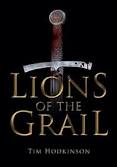
Tim Hodkinson writes an excellent blog, and is author of Lions of the Grail, about the knights Templar. His Amazon page is here.