The Lost Writing Partner: The Case of Charles and Caroline Todd
WRITTEN BY ALISON MCMAHAN
 What is it like for a writer to lose their writing partner after many years and books together? How does the survivor navigate the financial and legal aspects of a long-standing partnership? What happens to the work when the writing partnership ends?
“Charles Todd” was the pseudonym of Charles Todd and his mother Caroline Todd (those names are also pseudonyms). From 1994 to 2021 they wrote twenty-four novels and a short story in the Ian Rutledge series, and thirteen novels, a novella, and a short story collection in the Bess Crawford series.
Their career writing novels set in WWI England and France famously started on a Revolutionary War battlefield in 1992. Charles was a corporate fixer and took a day off to visit with his parents. On the way home Caroline said, “Why don’t we write a battlefield book? Or something about a war?” Charles was too busy driving to pay too much attention. But later, when his job morphed, he had to travel and spend a lot of long nights in hotel rooms. So he called his mother and asked her if she was serious.
They decided to write about the First World War in England. “Given the period, it means those villages are between social stages, shifting from an artisanal village to a more modern world,” said Charles. Mother and son both love England and recharged their creative batteries by visiting England once a year for research.
Charles tells of the moment he and Caroline were standing in a church tower in an English village and reading the list of the names of the war dead. This is how Caroline described that moment when I interviewed her in 2018: “So many of them had the same last name, so many of them had the same death date. At the Battle of the Somme, 29,000 died. These regiments were made up of recruits from entire villages. So, in one day all the men from an entire village were dead.”
The two worked closely together, though they lived in different states, and though Caroline was a pantser and Charles wasn’t. It took two years to arrive at a writing process: one wrote a paragraph and shared it with the other, who wrote the next paragraph. Some paragraphs were filed away to be used later. Some formed the basis of a scene. Charles adapted to Caroline’s pantser process, which led to them spending the most time on the opening scene, the scene that sets the rest in motion. They never knew how each book would end, or who was guilty, until they wrote the climax.
The pantsing approach also led to an emphasis on character. Their first effort, A Test of Wills (St. Martin’s Press, 1996), features Inspector Ian Rutledge, a Scotland Yard detective with PTSD who organizes everything about his life to keep his mental anguish secret. Charles speaks of Rutledge as a real and evolving person, saying things like “it was Rutledge who told us about Hamish.” In fact, Rutledge’s most recurrent symptom is a voice in his head, the voice of a young corporal named Hamish whom he had to execute for refusing to follow orders.
In 1996 they sent the book to a friend, Ruth Cavanaugh, an editor at St. Martin’s, not expecting anything, just looking for an opinion. Cavanaugh immediately made an offer and soon came back with an offer for the next two as well. The unexpected success was gratifying.
Mother and son agreed to publish under the name ‘Charles Todd,’ to keep the book spines less cluttered. They were clear with their publishers that the books were co-authored. But at the time they signed the first contract, Caroline was suffering from a heart ailment, and her doctors forbade her from traveling. Charles had to do a book tour of sixteen states in fourteen days on his own. Readers were not aware that the books were co-authored until the fourth book came out, when Caroline had recovered and was able to fully participate in the marketing effort. “It expanded our readership,” says Charles, “because there were some people who were delighted to know it was a mother–son writing team; apparently that is unusual.”
They agreed on how they would distribute any earnings. “We didn’t want money to get between us or become a problem later. So, as soon as Ruth Cavanaugh made us an offer for A Test of Wills, we set up a DBA corporation, mom was president, dad treasurer, I was secretary. Basically, all income from the books and charges from the books went into that bank account, expenses were deducted, and then each of us received an equal amount. My father watched over it all, and we went back to writing. We needed to concentrate on what we were doing and not how much money we were making or anything else.”
After the tenth Ian Rutledge novel, they started a second series, featuring Bess Crawford, a WWI nurse. The Ian Rutledge books start when the war is over and are written from a third-person point of view. The Bess books start with the war in full swing and are in first person. They wrote a book for each series a year until Caroline’s death in 2021 at the age of eighty-six.
After her death, Charles moved ahead with editing and publishing the two manuscripts they’d nearly completed for William Morrow. “So many times I wanted to pick up the phone and call Caroline. But in many ways, it was therapeutic; I tried to add in her points and suggestions into the novel, so it was like she was there next to me.”
Still, once he’d finished the last two books they’d written together, he had to adjust to a new routine of writing solo. He found support in the writing community, who invited him to speak at various conferences (he’ll be a Special Guest of Honor at Bouchercon in New Orleans in September) and he wrote half a dozen stories for various anthologies.
Readers continue to clamor for the Rutledge and Crawford books, so he planned to continue both series on his own. But there were difficulties. The biggest shock was that Caroline’s most recent will was written before their writing collaboration even began, and did not specify who would have the rights to her share of royalties after her death. Other family members had different ideas about Caroline’s share of the royalties and the book rights. That left Charles fighting a protracted legal battle with members of his own family, leaving the books in legal limbo until it was resolved.
“[When two people write together], generally it would be a 50/50 split,” says Charles. “If you die, your share of the royalties still goes to your estate and then your estate’s heirs. Not to your co-writer.” He recommends that authors make wills designating who their royalties will go to. That way the estate can cut checks to the heirs without the kind of hassle he had to go through.
Charles and Caroline always said that their writing was so interwoven that by the time they finished a book they could not say who wrote what. But now that Caroline is gone, Charles is finding it a challenge to continue certain thematic threads, such as Bess’s background in colonized India. Bess grew up in India’s North West Frontier, as did her friend and confidant, Simon Brandon, who as a young soldier served in the regiment in India led by Bess’s father.
The Todd novels and stories set in colonized India don’t tell about Britain’s weakening domination of their colony, but show it through a wealth of background details and subplots that often feature the fracturing of friendships and relationships that the young Bess takes for granted.
Charles knows he will have to get to this point eventually, because in Racing the Devil (William Morrow, 2017), Ian Rutledge, who has never met Bess, ends up getting some assistance from her on a case while Bess happens to be in India. The Rutledge books are about three years ahead of the Bess books chronologically, so this exchange of information and Bess’s trip has happened in the Rutledge narrative only. Eventually Bess’s narrative will catch up, and that trip to India will occur in her timeline.
The India thread of narrative was one that was almost exclusively Caroline’s. When she studied foreign relations, she had planned to go to India to teach English, but political events prevented that. Still, she remained fascinated with the country and its cultures and was overjoyed when she finally got to visit many years later. Now Charles is not sure how, or if, he will continue the thread.
The last Bess Crawford book that Caroline and Charles wrote together, The Cliff’s Edge (William Morrow, 2023), was the fortieth title published under Charles Todd, and William Morrow did not want to continue, even though the Ian Rutledge series is under option for a TV series. So he and his agent, Lisa Gallagher, continued to search for a new publisher.
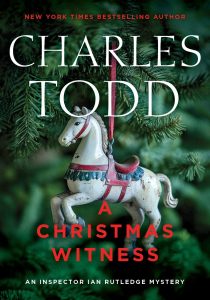
For three years after the death of his mother and writing partner, it was a struggle. Charles had to cope with his sense of loss, had to resolve thorny legal and financial issues, had to adjust to writing alone and to find a new publisher. Finally, there is good news on that front: Mysterious Press has agreed to publish A Christmas Witness, the next installment in the lan Rutledge series, a novella already available for pre-order, as well as the next two Ian Rutledge novels and the next Bess Crawford novel. Charles Todd fans rejoice!
References:
1. Alison McMahan
“Closeup: Charles Todd,” The Big Thrill, https://www.thebigthrill.org/2019/01/up-close-charles-todd/
2. Charles Todd
A Christmas Witness, Mysterious Press (October 21, 2025)
About the contributor: Alison McMahan’s stories are anthologized by Level Best Books, Wildside Press, Down-and-Out Books & HarperCollins. Two-time Derringer finalist and an Other Distinguished Mystery author, Best American Mystery Stories of 2018. https://alisonmcmahan.com
Published in Historical Novels Review | Issue 112 (May 2025)