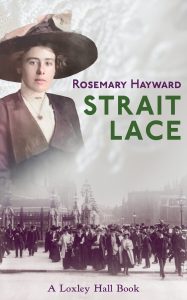
Launch: Rosemary Hayward’s Strait Lace
INTERVIEW BY LESLIE S. LOWE
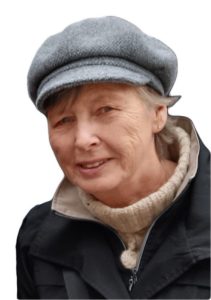
Rosemary Hayward was born in Hertfordshire, England, and studied English at Hertford College, Oxford. Since then she has lived and worked in Oxford, Nottingham, London, Bracknell and Santa Cruz, California, where she now lives. Strait Lace is her second novel and the first of the Loxley Hall Books.
How would you describe this book and its themes in a couple of sentences?
Strait Lace is the story of Harriet Loxley, a member of a family of Nottingham lace manufacturers in Edwardian England, who is determined that women should vote.
What inspired you to start writing historical fiction and what has been most rewarding about it?
I’ve always been fascinated by history. Historical fiction allows me to speculate on what can be never fully known, such as how a particular character felt about food, what clothes they chose to wear and what their sex life was like.
 How is this latest novel different from your first book, Margaret Leaving? There seems to be a common theme of main characters leaving their homes.
Strait Lace is pure historical fiction set in Edwardian England. Margaret Leaving is a historical mystery in which a young woman, Jenny North, uncovers shocking events about her step-mother’s role in World War II. It is true that both young women leave their homes near the beginning of the story, but they leave under very different circumstances. Harriet, in Strait Lace has the support and financial assistance of her family. Jenny in Margaret Leaving flees home by jumping from an upstairs window after her father locks her in her bedroom while he looks for the means to get her ‘cured’ of her attraction to women.
Why the focus on this topic now? Is there a historical event you found in researching that inspired you to write this story to portray a key message for now?
I think the book is relevant to our present, in which rights are being stripped away from women. But, to be honest, that wasn’t my motivation. My motivation was that I’ve always been fascinated by the suffragettes. The literature varies from them being depicted as unassailable heroines to being outrageous terrorists. There is very little fiction centering on suffragettes and how they felt about what they were doing.
How does Harriet transform within the story? What did that journey mean to you as you wrote it?
Harriet’s younger brother got to go to Cambridge University, leaving her behind in the useful, but limiting, role of helping her mother with her parish duties and caring for her elder sister’s children. An unexpected source of money from her lace-making uncle leads her to realize she can study biology as she always wanted. Then, meeting the Pankhurst women makes her see just how much women can do, if they are prepared to step beyond the bounds of propriety. As I was writing, I was coming to grips with what it meant to be so attached to a cause for which you would risk everything and what, for Harriet, was the ultimate thing she wouldn’t risk losing.
How do you think the reader will connect with Harriet in this book?
Readers see things I hadn’t known were there. Or perhaps I put them there subconsciously. I hope the reader will start out by appreciating the restraints Harriet lives under and how they affect her way of thinking. Then, as the story progresses, I hope they will care enough about her to be frightened for her.
How did you balance the research with writing the story? Did you find any interesting historical facts while researching?
When I decided to write about a suffragette I looked for inspirational material in towns I knew and found the fascinating story of Helen Watts, the daughter of the vicar of Lenton, Nottingham. In the 1980s a Bristol history teacher set his students a project. One student, choosing to write on the suffragettes, placed an advertisement in the local paper seeking information. A worker at the Avonmouth docks responded, telling her of a lost trunk they had in their possession containing letters and speeches belonging Helen Watts. The trunk was supposed to be going to Canada, or possibly returning, either way it never got back to Helen.
Apart from that initial inspiration, I did my research on details as I went along. I also read historical analysis, biographies and original writings of suffragettes and politicians, and fiction contemporary to the Edwardian period.
What are you working on now? Is it connected to this one or your Margaret Leaving in any way?
I am working on a companion story to Strait Lace, called Crocus Fields, in which a present-day descendent of the Loxley family returns to the home in Nottingham to clear it out after her mother’s death. A lost trunk (Harriet’s?) plays a part in what is essentially a drama built around the estrangement of a mother and daughter.
You were born in Hertfordshire, England and now live in Santa Cruz, California, with a second home in Seville, Spain. How have your life and work experiences been incorporated or assisted you in your writing?
I started one piece based in rural Hertfordshire, but it remains unfinished. If I ever set a work in California or Seville it would have to be from the point of view of an English person living there, because that is what I know and have experienced.
I drew on my work as an accountant for a subplot in Strait Lace and my time as a student at Oxford influenced the character of Jenny in Margaret Leaving but ultimately personal experience is not enough. There needs to be a good helping of imagination.
 Every author has their own publishing journey. Tell me about yours.
I began Margaret Leaving when my husband was on an assignment in California and I didn’t have a work permit. I put that draft novel away when we returned to the UK and resumed my teaching career. Five years later we were back in California and I met someone who encouraged me to attend a writers’ conference. The fun I had there sent me down the path of learning how to turn a first draft into a book.
Seventy-five rejections from agents later I decided that getting Margaret Leaving into the hands of the people I knew was more important to me than landing a traditional publishing contract, so I self-published through CreateSpace.
All the time I was writing Strait Lace and Crocus Fields, I was debating whether to try the traditional publishing route again. Then a friend told me it took her twenty years to get from writing her book to getting it picked up by a publisher. I’m not sure I have twenty years left!
What advice would you give to other aspiring historical writers?
Historical fiction is as much about world building as science fiction is. You have to make the time and place you are writing about real for the reader. Hilary Mantel is a master of that. Read the Wolf Hall books and A Place of Greater Safety. Listen to the Reith Lectures Hilary gave back in 2017. She is thoughtful in her analysis of how she does what she does and generous in sharing it.
What is the last great book you read? Why?
Doris Kearns Goodwin’s Team of Rivals, a detailed insight into the years of Lincoln’s presidency, the other extraordinary men he worked with and the political tensions involved in the prosecution of the war. It’s history written with all the skills of a novelist.
HNS Sponsored Author Interviews are paid for by authors or their publishers. Interviews are commissioned by HNS.