Kate Mosse On Putting the Women Back Into History in The Map of Bones
 BY LISA REDMOND
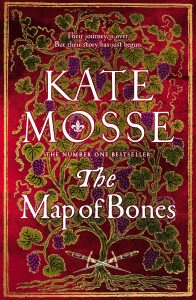
Kate Mosse has brought her Joubert Family Chronicles to a close with her most recent novel The Map of Bones (Mantle, January 2025). The series is a vast historical family tale which began in 16th century Carcassonne when the French wars of religion led to the expelling of the Huguenot population. The series has travelled through the centuries from France to the Netherlands, the Barbary Coast to South Africa.
I asked the author about her latest novel and the journey this series has taken her on. “The inspiration for all of my historical adventure stories is place – the heart-breaking landscape of southwest France in Carcassonne, the elegance of Paris, the enigmatic waterways of Amsterdam and now, in The Map of Bones, the epic majesty of southern Africa,” Mosse says. “[The Africa inspiration] comes from spending so much time there, so knowing the quality of light at different times of day and the way the shadows fall on the mountains; knowing the feel of the air in the summer and the crazy storms in winter; the heat of the African sun and the glory of the birds and wildlife that is so different from anything we have in Europe.”
She adds, “I research for years – not just visiting repeatedly the place the novel is set, but spending time in archives, libraries, museums, doing everything to get under the skin of life in the 17th century. I walk the streets my characters would have walked in my imagination, mapping the lost world against what a modern-day reader might see today. The actual writing is almost the shortest part of the process. I want readers to feel that they are there, that they can imagine what it would be like to live in the past and to face the challenges my characters face.”
For this author, the writing process is also an immersive process. I asked her whether she uses a discovery draft or is a meticulous planner. “Everything comes from research and being utterly immersed in the history and the landscape for years before I ever sit down at my desk,” she told me. “I love your phrase ‘discovery draft,’ because that’s exactly what it is like for me. My first draft is all emotion, it’s all about finding out what the real story is – that’s to say, the story of my imagined characters against the backdrop of the real history I know so well.
“The inspiration for The Joubert Family Chronicles began in Franschhoek in the winelands of the Western Cape back in 2012. Visiting the Huguenot Museum, I discovered this hidden history of a handful of 17th-century refugees from France who’d fled persecution and built a new life in the wild, pioneer lands of southern Africa. Standing in the Huguenot graveyard, in the shadow of the Franschhoek Mountains, I suddenly had a vision of a woman in the 19th century leaning forward and rubbing the lichen from a grave to reveal the name of the person buried there. I had to start writing to discover who she was. Twelve years and four novels later, I finally got my answer! You’ll have to read The Map of Bones to find out who she is and what she is doing there in that graveyard so far from her home in England.”

author Kate Mosse
Mosse has always championed women in history. Her recent nonfiction book Warrior Queens and Quiet Revolutionaries (Mantle, 2023) will be released in paperback this year and Mosse tells me that 2025 will also see the publication of her first YA book, “called Feminist History for Every Day of the Year (Macmillan Children’s Books). Each day tells a key story for women and girls and puts women and girls of the past and present centre stage.
“Women and men built the world together, it’s just that the writing of history – as opposed to the living of it – has too often ignored or overlooked women’s stories. At the heart of everything I do is the desire to tell the whole story, in other words to acknowledge the contributions of all the people who played their part – women as well as men, different races and religions, different periods of time. If history is only the work of half of the population, then it can’t really be called history at all. My novels put in the spotlight courageous, independent, strong women who are determined to live life on their own terms and not be confined because of their sex. They also feature lovely, gentle men who, also, want to be allowed to live a different, better kind of life. In The Map of Bones, Suzanne has suffered a great trauma, but she is determined not to let it define her. She is on a quest to discover the stories of her ancestors and put the women of the Joubert Family into the history books. It will fall to her ancestor, Isabelle, coming nearly two hundred years later, to finally put pen to paper.”
I asked Mosse whether she plans to revisit any of these characters and what she might work on next.
“It is the twentieth anniversary of my novel Labyrinth (Putnam), which got into the hands of readers all over the world and changed my life. To say thank you, and to share that journey, I’ll be performing a new one-woman stage show inspired by the novel, sharing my journey with readers and giving a glimpse into the real history behind the fictional story, from Nazi Grail hunters of the 20th century to Ancient Egypt centuries before. I’ll be touring the UK in Spring 2025, and I can’t wait to be back on stage.
“Your readers might also know I’m the Founder of the Women’s Prize for Fiction and now our sister prize, The Women’s Prize for Non-Fiction. The fiction prize will be celebrating its 30th anniversary next year too, so that will keep me rushed off my feet with special events, interviewing some incredible women, and we’ll have a huge celebration of all our amazing writers and writing alumna from our mentoring and writing programmes in London in June. Only when that is over will I be able to get to my desk and start my new novel. I have an idea for a series of crime novels inspired by cold cases, that’s to say unsolved murders, in Sussex, where I live in England: one is set in the 1920s, about five hundred yards from where I live; another is set just after the Second World War in a neighbouring town; and the first is a murder within my own family which I only learnt about this year! I love crime fiction and, finally, I’m going to get the chance to write in this genre.”
As for the Joubert family, “It was incredibly emotional writing the final chapters,” Mosse says. “These characters have kept me company in my dreams for more than twelve years now, so it was hard saying goodbye. But The Map of Bones is a proper full-stop, bringing to an end three hundred years of storytelling from 16th century France to 19th century South Africa, then London, and it’s time to move on to new stories. I am so grateful to readers all over the world who have taken the Joubert family to their hearts and fallen in love with the stories of adventure, discovery, hidden secrets, and pioneering women.”
About the contributor: Lisa Redmond blogs at The Madwoman in the Attic about women writers and historical fiction. She is currently working on a novel based on the 17th-century Scottish witch trials.