Dark Stories: A Conversation with YA Author Steve Watkins
WRITTEN BY TRISH MACENULTY
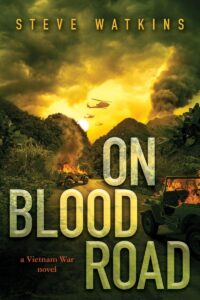 Steve Watkins, author of the young adult novels On Blood Road, Juvie, What Comes After, Great Falls, the middle-grade novels Down Sand Mountain, Sink or Swim, and the ‘Ghosts of War’ series, has sold more than 1.5 million books.
A former professor of journalism, creative writing, and Vietnam War literature, his most recent book, Stolen By Night (Scholastic, 2023), tells the story of a French teenager named Nicolette who, along with her friend Jules, resists the Nazi occupation of Paris by committing acts of vandalism and creating pamphlets to disseminate information, even though her own father supports the occupiers. One night she is snatched off the street by the Nazis. Her friends and family have no idea what has happened to her. “Night and fog” — the Nazi practice of “disappearing” their enemies — is one of many tactics used to cow the populace.
Watkins was inspired to write the story after reading about the myths of the French Resistance: “There’s this romanticized trope that all the French were part of the Resistance from day one,” he said. “But many French citizens thought the Germans would bring a needed discipline to their country.” He was struck by the fact that there were three million cases of French people reporting their neighbors to the Nazi authorities. “It was a sinister climate,” he said.
The storyline of young rebels fighting an oppressive occupier is ideal for a young adult novel since, according to Watkins, it was principally young people who resisted the oppression of the Nazis.
“Teens were the driving force. They were on the front lines, disrupting the occupation by defacing Nazi signs and symbols and sharing information from illegal sources.”
Present-day events also inspired Watkins to write about the teenage fighters.
“Two of my daughters were involved in the Black Lives Matter protests. Young Americans were putting themselves out there, getting arrested, and tear-gassed. They got a crash course in the mendacity of people in power when they saw protesters falsely accused and arrested,” he said. “All of that spoke to me as I was getting into the mindsets of Nicolette and Jules. Of course, the stakes were vastly higher in World War II.”
After she disappears, Nicolette winds up in Natzweiler-Struthof, the only German/Nazi-run concentration camp on what is now French soil. Watkins said the camp did not have the notoriety of the other camps because it was smaller, and yet the conditions were brutal, involving forced labor and pseudo-scientific medical experiments. More than 22,000 prisoners died in the camp system.
“The things I write about in the camp are all factual, including the medical experiments,” he said. “The challenge is to honor the sacrifices of those people who were tortured, abused, and killed.” The other challenge, Watkins acknowledged, is how to write about such dark subjects for a young adult audience.
“There are various ways to elide the realities. And yet I wanted an honest and frank exploration of what went on in the concentration camps. I wanted to see if my publisher would let me tell the real story.”
In Stolen by Night. one of the topics Watkins avoided was the sexual abuse that a female prisoner would have endured. Nicolette is young and half-starved. Forced to watch other prisoners hang, she is given the gruesome task of disposing of dead bodies. Eventually, she winds up as a server in the officers’ mess hall, which offers her a measure of protection.
“I read a lot of the transcripts of the Nuremberg trials, which were just unspeakably horrific. I had to be as honest as I could, but at the same time, write at an appropriate level for young readers,” he said. “A good editor is helpful. I didn’t want to sugarcoat or romanticize what happened in the camps, and my editor helped me straddle that line.”
Watkins wound up writing YA novels by accident. His first book was The Black O (University of Georgia Press, 1997), a nonfiction account of racism in corporate hiring practices. Then he wrote a novel set in Thailand during a military coup. “Nobody wanted any piece of it,” he said.
So he wrote Down Sand Mountain (2008), a coming-of-age story set in 1966. His agent didn’t think she could sell it, but a young woman who had just started at the agency picked it up and sold the book to Candlewick Press. “I didn’t realize I was writing YA until we sold it,” Watkins said with a laugh. The book went on to win the Golden Kite Award for Young Adult fiction.
After spending several years as a court-appointed advocate for children, Watkins found he was well suited to write stories for younger readers. “I would investigate and write reports. I heard stories and had lots of experiences working with young people,” he said. These experiences gave him a sense of children’s lives and what young people wanted to read. He wrote his next three or four books for young adults, and eventually Scholastic wanted to work with him.
Watkins describes a varied landscape for writing for young people today. He said that a lot of publishers are looking for the “crossunder” book, those that appeal to more than one group.
“If a book is both young adult and middle grade, that informs some of the decisions,” he said. “A YA book may have decent sales, but if it also appeals to middle graders, then the sales can be much greater with classroom and libraries picking up the books.
“There’s also some of that going on with YA and adult publishing,” he continued. “Some writers create a YA version of their adult books.”
YA and middle grade books provide an avenue for inspiring the next generation.
“Young people care about issues and see them in an existential way. One of the things that historical fiction can do is whet their appetite to learn more. My responsibility as a writer is to offer a perspective and a challenge to take the information and run with it,” he said. “As writers we open doors.”
Watkins is currently working on another historical YA novel and edits the online magazine, Pie and Chai.
About the contributor: Trish MacEnulty’s historical YA novel, Cinnamon Girl (Livingston Press at the University of West Alabama) came out in September 2023.
Published in Historical Novels Review | Issue 106 (November 2023)