Conflict under a Greek sun: The House of Hidden Letters by Izzy Broom
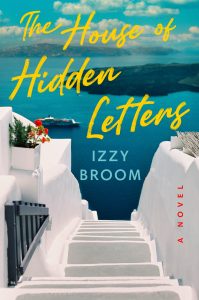 BY MARILYN PEMBERTON
The choice of location for a novel is vital and often quite problematic but for Izzy Broom it was an easy decision. A two-week vacation on the Ionian island of Zakynthos over 25 years ago, was the first of an ‘annual pilgrimage’ that eventually led her to work there for the whole summer in a cocktail bar.
‘I made friends for life, collected memories I still cherish to this day, and fell even more in love with the Greek people and their culture,’ she says. This is why, ‘When I knew this novel was going to be hooked around the one-euro property scheme, Greece felt inevitable as a setting. It was vital that I found an island a little more off the beaten track, one that had been occupied by both the Italian and German forces and that possessed something elusive and magical, a quality that only reveals itself once you step foot on its shores. My research led me to Folegandros, which seemed to tick every box. All that remained was to visit, and the moment I arrived, I knew I’d chosen the right place. I felt it immediately, that unmistakable tingle of connection.’
Izzy Broom is not only a fan of Greece, but also of ‘split-narrative novels – especially where one storyline is set in the past.’ The House of Hidden Letters (Berkley, March 2026) tells of two women: Katerina, who was born on the island and suffered its occupation by Italy then Germany during World War II, and Skye, who, in the present day, wins a one-euro villa on the island and takes the opportunity to escape from her mentally abusive husband.
Broom explains that, ‘Initially I’d planned a structure where all the wartime chapters would be letters. After all, epistolary novels such as The Guernsey Literary and Potato Peel Pie Society work brilliantly. However, I found that the format was limiting me when it came to Katerina’s character. As soon as she appeared on the page, she was a force of nature, and I chose to lean into that energy rather than contain it. It felt as if she was demanding more of me and I’m confident that writing her scenes in a more immediate style was the right decision.
‘Having a dual timeline also gave me plenty of opportunity to play with voice. I love the contrast between my two leading women. Katerina is fiery and headstrong, and much of what she says is instinctive, whereas Skye has learned to frame her words more carefully, given that she’s a teacher. The two women are similarly courageous, smart and compassionate, but while Skye is conflict-averse and easygoing, Katerina is tough and uncompromising. They complement each other, and there is much about both women that I admire. I’m a big believer in the importance of character – the more distinct and relatable they are, the more enjoyable the reading experience. That’s my hope anyway.’
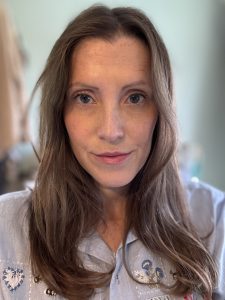
author Izzy Broom
The Greek island that Broom loves today is a very different place to what it was during World War II, of course, and for her research she read ‘books by writers such as Victoria Hislop, and reading those provided a rich tapestry on which to grow my own story. For this book, I also dived into non-fiction, devouring Inside Hitler’s Greece by Mark Mazower. Additionally, I uncovered a series of articles online, which featured letters and diary extracts written by Greeks at the time of occupation. The joke Stefanos makes to Katerina, about bringing an Italian soldier home for her to keep as a goat, came from one of those letters.
I also visited a Greek friend of mine in Athens, and he very kindly took me out for a souvlaki lunch and allowed me to ask him a multitude of questions. I heard stories that had been told to him by his giagia (grandmother) when he was growing up. She was on another Greek island, Kefalonia, during wartime, and had witnessed some truly horrendous atrocities, including the murder of her own husband.’
Unfortunately, Broom didn’t have to do much research into contemporary mental abuse and its consequences. She explains that ‘I have a close friend who was trapped in an abusive relationship for many years, with a man who belittled, bullied and threatened. It was only when those threats slipped into physical violence that she found the strength to leave, but it was a long and difficult process. There were young children involved that he used as pawns in his vile game, and she had to fight hard to extricate them and herself from harm. I knew from her experience how to tackle the topic, but I also listened to a series of programs on BBC Radio 4’s Women’s Hour, which focused primarily on coercive control.
‘When it came to writing those scenes, I found it depressingly easy to slot myself into Skye’s shoes. There have been numerous instances in my life where I have felt unsafe around men. Don’t get me wrong – I like most men. I have a lot of male friends, and my past relationships have almost all ended amicably. But I have seen how some men can be, how aggressively some appear to loathe women. I kept all of that in mind when I was creating Martyn’s character.’
The topic of mental abuse is indeed a difficult one and Broom is not suggesting that all victims attempt to win a lottery and escape to a Greek island. What she does hope is that any readers of The House of Hidden Letters, who may be experiencing mental or physical abuse, realise that they ‘are not alone. Abusers want to isolate their victims – it empowers them. But you are never on your own. Talk to friends or family, reach out to someone you trust. As Skye and Katerina discover in the novel, there is great strength in community. My aforementioned friend would message me and others with details of any threats or cruelty she’d suffered, and we kept a log, so she didn’t have to. When it later came to providing evidence, it was all there, time-and-date stamped.
‘I would also say trust your instincts,’ Broom says. ‘If something feels wrong, chances are it is. If your gut is telling you to run, listen to it. A partner is there to love and support you, make you feel safe. Keep a tally, and if the bad days outnumber the good, take that as your sign to leave. There are several organizations you can reach out to for help and advice. These include the National Domestic Violence Hotline, Crisis Text Line, StrongHearts Native Helpline, End Coercive Control USA and WomensLaw.org.’
About the contributor: Marilyn Pemberton has a passion for fairy tales that subvert and challenge social mores. Victorian fairy-tale writer Mary De Morgan was the subject first of a biography, then a fictionalised life in The Jewel Garden. Marilyn has published four novels from her historical series, Grandmother’s Footsteps, which include her own fairy tales as a means of critiquing the society in which her female protagonists live. Marilyn has also published two stand-alone historical novels, Sold for a Song and Under the Eye.