The House of Barbary by Isabelle Schuler: A retelling of Bluebeard
 BY LISA REDMOND
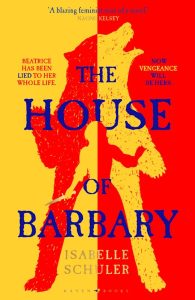
Isabelle Schuler is a talented author making a splash in the area of feminist historical fiction; she is also a filmmaker, screenwriter and former actress. Her first novel, Queen Hereafter (Harper, 2023), a retelling of Macbeth from the point of view of Lady Macbeth, began as a screenplay and her second novel, The House of Barbary (Bloomsbury, 2026) is also a retelling: of the Bluebeard fairytale set in Bern, Switzerland in the 17th century. I asked the author about her latest book, in which she once again illuminates a historical period and all of its pressures and prejudices through the eyes of women. Beatrice Barbary has grown up as the indulged only child of one of Bern’s most powerful men and when he is murdered, she is determined to find out who killed him and why.
“While I’d known about the fairytale since I was very young thanks to a book of ‘children’s’ fables, it wasn’t until I was researching the original source in Charles Perrault’s ‘Mother Goose Tales’ out of curiosity that I discovered the two morals at the end roughly paraphrased as follows: firstly, nosy women will only ever be grieved by their curiosity, and secondly, we can thank God that men like this no longer exist,” Schuler explains. “I read that last moral during the autumn of 2017 in the wake of Harvey Weinstein. I felt compelled to reimagine Bluebeard in such a way that would overturn these morals. For a long time, I had the bare bones of the story without the embodiment of time and place. Then, in the summer of 2022, I came across a painting: “The Rape of Prosperina” by Italian Baroque painter Simone Pignoni. It’s a staggeringly visceral painting, in which light and dark are at war. This painting then led me to research the violent 17th century, which I thought would suit the story perfectly. As for Switzerland, my father is Swiss, so I wanted to honour him by setting the story in his home country, which worked spectacularly well as the mid-1600s was a time of great upheaval in the city of Bern. And I’ve always loved the bears of Bern.”
The novel is dark, atmospheric and at times incredibly claustrophobic especially as the truth of Beatrice’s father’s involvement in the mysterious Order of St Eve is slowly revealed. “I was …fascinated by the idea of this place that had once felt safe, becoming a prison as her awareness grew… to heighten the themes around how people present versus how they behave in private nicely… I wanted to capture that sense that no one is who they seem to be, everyone knows more than they’re willing to share, and everyone has their private motivations for staying in the orbit of the powerful Jakob Barbary.”

author Isabelle Schuler
There is a dark edge to all the characters in the novel, including those with whom we empathise. Beatrice’s mother died young and her maid Imerla is therefore a strong influence on the younger woman.
“I was also fascinated by creating a question of power imbalance,” Schuler says. “On the one hand, Imerla is Beatrice’s maid, and so there is an inherent, societal difference in their power. But on the other hand, Imerla is the only female influence in Beatrice’s life. She, Imerla is older than Beatrice, and more aware of what’s going on in the home, which gives her a different, more subtle, kind of power over her mistress. With Imerla being the only real female influence in Beatrice’s life, their relationship was always going to be one of intimacy and intensity.”
There is also a cinematic quality to Schuler’s writing, unsurprising since she also writes for the screen and the gothic influence are clear, “Growing up, Frankenstein, The Picture of Dorian Grey, and Jane Eyre were my favourite novels. But I am also immensely influenced by visual sources as well and spent a good deal of time studying Baroque painters like Caravaggio, Bernini, and Pignoni. I tend to think quite cinematically as I’m writing – I can picture it all unfolding in my head – and so directors like Guillermo Del Torro were very influential in my writing process. I must have watched Crimson Peak at least half a dozen times to fuel my imagination.”
As for what’s next: “I love writing historical fiction, because of the grounding force of human nature that, as far as we can tell in the thousands of years of storytelling, has shifted very little,” Schuler says. “Governmental and societal systems may have changed, but we have not evolved beyond jealousy, hubris, or hate. Nor are we any less moved by love, joy, and goodness. We desire. We destroy. We steal. We sacrifice. The human condition remains intact, and if we look beyond the tropes, we find something in the narratives of this particular century that resonate even now. That being said, I also love the idea of speculative fiction and historical fantasy. I’ve written a book that uses elements of speculative fiction to augment certain themes I’m drawn to, particularly desire, in the midst of historical period I’m very interested in. But more on that to come.”
It certainly seems that for those of who are interested in reimagining the lives of women in the past, Isabelle Schuler is an author to watch.
About the contributor: Lisa Redmond blogs at The Madwoman in the Attic about women writers and historical fiction. She is currently working on a novel based on the 17th-century Scottish witch trials.