In the Man’s World of the Past – Jenny Barden in conversation with C. W. Gortner
Jenny Barden
C.W. Gortner is the internationally bestselling author of The Confessions of Catherine de Medici, The Last Queen and The Queen’s Vow, as well as The Tudor Secret, the first in the Elizabeth’s Spymaster series. He is already recognised as one of the finest historical fiction authors of his generation, and he has made a specialty in focusing on some of the most powerful women of the Renaissance.
Jenny Barden‘s debut novel, Mistress of the Sea, is published this week by Ebury Press, Random House. Jenny is programme director and co-ordinator for HNSLondon12, our UK conference this year. She describes herself as an artist-turned-lawyer-turned-writer.
JB: One of the greatest challenges faced by any author of historical fiction must be that of building empathy between readers today, having modern values and mores, and historical characters, whether fictional or real, who would have had a very different way of looking at the world. Where women are concerned, this is bound to be especially difficult since their roles and expectations have changed so much over past centuries. Could you say how you have tackled this conundrum – and has it led to any memorable issues in your writing?
CWG: It always leads to issues. As much as we want to sanitize and empower the past, the stark reality is that for most people, and in particular women, the past isn’t a pleasant place. The world was often dark, cruel: there were no civil rights. It’s therefore a challenge to depict these women in ways that modern readers can identify and empathize with, simply because we see the world in such different terms. We reflect our notions onto the past, which explains why we are so endlessly fascinated by ladies like Anne Boleyn, whom we perceive as bucking the system. Yet we also know that even a queen could find herself prey to the male-dominated society in which she lived: this is not a flaw of her character, but rather an unfortunate reflection of her era. What I try to do is find the similarities with our experiences. 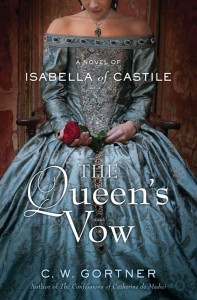 For example, Isabel of Castile is famous for being a warrior-queen. This image of course evokes a modernized view of her charging into battle in a breastplate. The truth is more complex, far less Hollywood. She helped plan battles, yes; she went to the front to support the troops, but she didn’t ride into battle simply because her husband the king did and they couldn’t afford to both risk their lives and expose their realm to a certain struggle for power. Isabel saw Spain as a child she must protect: and that is a sentiment we share. We know the need to protect our children and many of us are patriotic. It’s a matter of finding common ground that can form a bridge between past and present.
JB: As an author you’ve concentrated on some of the most notable women who played a role in the history of the Renaissance era, yet we generally think of noble women at this time as being very constrained, usually married off young by their fathers, their primary function being to beget male heirs. How have you managed to invest your heroines with enough freedom of action to make them interesting to readers now?
CWG: They themselves have invested it; they display it within their lives. It’s just a matter of looking deep enough to find it. Women were constrained, both at the top of the pecking order and at the bottom: that is the reality. However, the women I’ve chosen to write about still show strength of purpose and character. I don’t think of them as ‘heroines’ because that term evokes, for me, high expectations: these women are not Xena, Warrior Princess. They struggle with the confines of their gender and particular circumstances; it’s their struggle; that fight against the tether, though they may not succeed, which fascinates me. I am always drawn to the subtleties of life, to how we navigate the seemingly anarchic circumstances we are handed, often through no fault of our own. For example, Catherine de Medici was married  at age 14 to a foreign prince she had never met; she endured years of marriage to him, when he was obsessed with his mistress. She undoubtedly suffered humiliation. Yet within that very marriage, which has so often been proclaimed as loveless and stifling, in which she’s indisputably at his mercy, Catherine manages to forge an unexpected unity. Her husband comes to rely on her; he entrusts her to rule in his absence, he seeks out her advice. She fights to prove her value, and in the end she becomes more important to him than his mistress, even if he doesn’t realize it. His sudden death shatters Catherine; this is not weakness on her part, as many have claimed. I believe she genuinely mourned his loss, because despite his flaws, they had found accord. This is freedom of action to me: this is a woman who makes lemonade out of the bitter dregs that life has served her.
JB: Women are being given particular prominence in historical fiction at the moment, perhaps because in times gone by they have been rather neglected by historians, but you seem to be going even further than filling in the gaps – you have taken women who have been demonised or maligned and shown them in a new light. Catherine de Medici, traditionally viewed as the evil murderess behind the St Bartholomew’s Day Massacre, is portrayed sympathetically in your novel about her, and the behaviour of Juana ‘the Mad’ becomes understandable in The Last Queen. Has there been a deliberate attempt at rehabilitating these women on your part? – or are these characters who fascinate you, who have become more real, and ‘human’, as you have brought them back to life in your fiction?
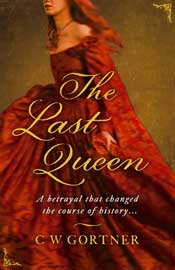 CWG: A bit of both, I’d say. I’m drawn to secret histories: there must be something untold, often controversial, to spark my interest. Again, it can be subtle; but I’m rarely attracted to an easy story. Juana epitomizes this: she’s known as the mad queen, who was so deranged she dragged a coffin around with her while her kingdom fell into chaos. My first question was: Why would she do this? My next questions are: Is it true? And if so, how did she end up this way? What happened to lead her down this particular path? I do think that many famous women, and men, suffer from a calcification of their myth: we see them in a certain way because centuries of what we call ‘history’ has made them thus. But there are truths within truths; facts aren’t always facts. Knowing this, I do seek to rehabilitate to a certain extent, in that I want the reader to consider an alternative point of view, a different truth than the one we’ve been told. I don’t, however, make it up. There must be some seed within that life, as there’s been in each of my characters’, to warrant further exploration. They do become more human, more real, as I explore: how can they not? Once we dig under the mire that has been heaped on Juana, you find a young infanta who tried her best to be a good consort to an undeserving prince; a mother torn from her children; a queen determined to defend her country. No one is just one thing. We are composed of different parts, often contradictory. I want to flesh out those contradictions in my fiction.
JB: The minutiae of daily routine must have filled much of the time available to the women you write about: dressing, eating, grooming and praying. Plainly your research has been meticulous, but were there any surprises you came across – details about habits and customs that perhaps you felt loath to include because they would appear too alien to readers today?
CWG: Yes, to a certain extent. I found details that I was overjoyed to discover; for example, Catherine de Medici refurbished a crumbling menagerie in Amboise so the lions would be better housed. Isabel of Castile decided to learn Latin after she became queen and championed women’s education. Juana stood up to the king of France when no one else dared. And then, there are the aspects of the characters which we’d find tough to condone and I was indeed loath to include, though I did anyway, such as Catherine’s lack of public remorse or Isabella’s decision to authorize the Spanish Inquisition. I don’t try to make the unpalatable less so; I do try to elucidate it. That said, there are certain details of life in the past which I don’t dwell on incessantly. While I strive to convey an authentic sense of the era, we can only take so many mentions of the lack of sanitation and rampant cruelty. We don’t want to hear how dirty everything was over and over; few of us want to be reminded on a regular basis that those gorgeous gowns sweeping the floors could not be dry cleaned or that lice infestations were endemic or that animals died by the hundreds in baiting pits, their bloody ends often enjoyed by those very queens we admire.
JB: We’ve come to think of the great women of Renaissance times as ruling through men since the organs of sovereignty were then so male-dominated (the church and judiciary, administration and the military), yet is this too simplistic a view? Do you think women had more authority than has generally been credited, perhaps through sexual manipulation, perhaps through other means?
CWG: Oh, absolutely. In Castile, as in England, a woman could inherit the throne as sole sovereign. Isabella wore her crown in her own right: she didn’t rule through male authority any more than Elizabeth I did. Juana’s tragedy was, arguably, the fact that she held more power than her husband by legal mandate. Women indeed had more influence and authority than history tends to credit, and they played crucial roles in the shaping of their countries. Was there sexual manipulation? How could there not be? Women have always used the weapons at their disposal: sex is one of those. But they also used acumen, intelligence, compromise, and ruthlessness as much as their male counterparts. I find it a fallacy to see the past in black-and-white terms.
JB: What’s your favourite instance from the past that gives an insight into the true relationship between women and men in the sixteenth century?
CWG: Isabella of Castile’s coronation: her husband Fernando was away when she unexpectedly became queen. There was danger all around her; she had to seize the moment. She had no time to send a message to Fernando and await his reply. When he arrived in Castile, you can imagine his reaction. And he let everyone know it, especially Isabella. What did she do? She set herself to creating the illusion of equality. This is the true relationship: she’s doesn’t submit because he throws a tantrum. She rolls up her sleeves and goes to work.
 JB: The Elizabeth’s Spymaster series is a departure for you in that it does not focus on one woman – this is not a story about Elizabeth I, but about conspiracies and power struggles in Tudor England. Do you think the balance of power between men and women was in general any different in England than on the continent at the time?
CWG: I think the balance of power was, to a certain extent, influenced by the particular country’s circumstances and history; but overall, few sovereign queens had been successful before the Renaissance and even fewer men believed a woman could rule. That said, I think England had a unique period in that within a relatively brief span of time, we experience a dizzying six queens for one king; then, after a brief kingship, we see one of England’s first sovereign queens mount the throne as Mary I, her tumultuous and tragic reign followed by Elizabeth’s. I would imagine that for those who lived through these events – and the longer-lived got to see most of it – the balance of power must have appeared skewered, even at times to be crumbling. I believe that after everything that came before her, the nation was primed for Elizabeth. It’s the main reason I set my Spymaster series within this particular crevice in time, just before she comes to the throne, as England is convulsed by the after-effects of the break with Rome, the death of Henry VIII, the fractious reign of Edward VI, and disappointment of Mary I. Elizabeth is fascinating because she arrives on the scene just when we need her the most; and she proceeds to play the game of power, both politically and between the sexes, with a startling ingenuity. I always smile when I come across a mention of that old legend that she was secretly a man, because she cultivated both the masculine and feminine in equal parts. That legend is an illusion which she herself set out to create. She would have laughed at the legend, I’m sure: laughed and loved it.
JB: This leads me onto one last question: Will you ever write a novel about the life of the Virgin Queen?
CWG: Oh, of course! She’s an incredible woman, an icon; yet also extremely fallible and prey to neurosis, the best and worst of both her parents. She’s an historical fiction writer’s dream. But, she’s also been covered quite a bit and I’d have to feel as if I had something fresh to bring to her story. I think for now, my Spymaster series gives me that. If all goes well, I’d love to continue to write about Brendan’s work as a spy on Elizabeth’s behalf. Her reign was long. There is so much opportunity to explore through their fictional relationship. He is my witness to history; thus, he can experience his life through hers, in ways that provide that unique angle I always seek.
JB: Thank you so much for agreeing to be spotlighted in this way, and for giving such fascinating and enlightening answers.
CWG: So lovely to be here; it’s my pleasure. Now, if I may be so bold, I’ve had the wonderful opportunity to read and endorse your upcoming novel Mistress of the Sea. I enjoyed it so much, in particular the unique story it portrays. Could you please tell us a little about the book? Also, what drew you to this particular place in time and what do you think it says about the role of women in our male-dominated past?
 JB: That’s kind of you to ask. Mistress of the Sea is an epic Elizabethan romantic adventure set against the backdrop of Francis Drake’s first great enterprise: the attack on the Spanish ‘Silver Train’ in Panama. You’ve already read the story, and picked out the fact that it features ‘a girl who flees the confines of her world’ in your wonderful endorsement. My central character, Ellyn Cooksley (purely a product of my own imagination!), escapes the loveless marriage planned for her by stowing away aboard Drake’s ship bound on a secret voyage to the Indies. As for what it says about the role of women in the past, at the heart of the story is one woman’s bid to make her own choices which leads her into danger and a need for courage and resilience, but also sets her on the pathway to finding love and coming to terms with the self-sacrifice this demands. In many ways the issues she confronts are timeless, though the conventions of the age were very different. What I particularly liked about the idea of introducing a woman into the adventure was that the ‘testing to the limit’ that everyone involved would have gone through would necessarily have broken down most of the conventional restraints. Ellyn is fictional, but she represents the many women we know about who did play a role in the pioneering exploits of the Age of Discovery, women such as those who took part in the first attempt to found a permanent English settlement in the New World: the ‘Lost Colony’ of Roanoke, which I’m writing about now. Women may not have worn the breeches, but they did exhibit extraordinary endurance and determination. One of my favourite quotes comes from James Lockhart’s Letters and Peoples of the Spanish Indies and a letter of 1556, sent by Doña Isabel de Guevara in Asunción, Paraguay, to your Princess Juana who was then Regent in Spain. Doña Isabel says:
Very high and powerful lady:
Several women came to this province of Río de la Plata along with its first governor don Pedro de Mendoza, and it was my fortune to be one of them. On reaching the port of Buenos Aires, our expedition contained 1,500 men, but food was scarce, and the hunger was such that within three months 1,000 of them died… The men became so weak that all the tasks fell on the poor women, washing the clothes as well as nursing the men, preparing them the little food there was, keeping them clean, standing guard, patrolling the fires, loading the crossbows when the Indians came sometimes to do battle, even firing the cannon and arousing the soldiers who were capable of fighting, shouting the alarm through the camp, acting as sergeants and putting the soldiers in order, because at that time, as we women can make do with little nourishment, we had not fallen into such weakness as the men….’
I often think that women did much more at this time than the history books would have us believe!