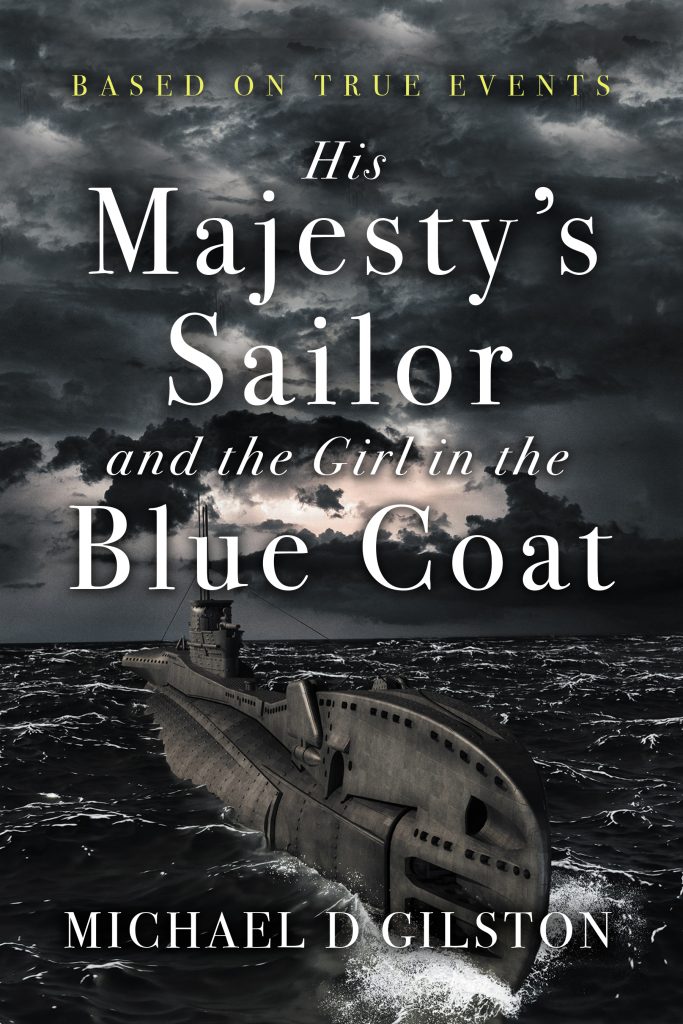
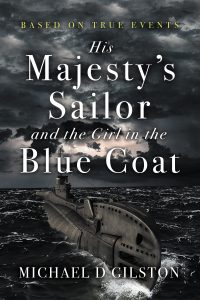
Launch: Michael Gilston’s His Majesty’s Sailor and the Girl in the Blue Coat
INTERVIEW BY ELLEN IRWIN
Michael Gilston is a retired Certified Safety Professional, married 45 years with three children and five grandchildren. His love for family and his lifelong passion for historical research led him to write the heartfelt His Majesty’s Sailor and the Girl in the Blue Coat, a novel based on real events experienced by his mother, Evelyn Jackson, and his great-uncle, Dominic, during the Second World War. Michael feels a strong call to preserve these stories for his children and grandchildren and whoever may come after, so that they will remember.
 How would you summarize your novel to readers?
It is the fall of 1942, and the Second World War rages on. The skies above Britain and the oceans around her are a battleground: German bombers target cities like Liverpool and Crewe, while U-boats and warships prowl the waters between England and France. Ten-year-old Evelyn Jackson and her parents live on rations, waiting for the sounds of the air-raid sirens above them and wondering what will come of their far-flung family in times of war.
Meanwhile, one of her uncles—Submariner Dominic King—serves as Helmsman aboard HMS Tuna. He and his crew are under constant threat of German U-boats and aircraft as they complete their ever-demanding war patrols—from delivering marine commandos off the coast of France to protecting the Arctic convoys in the North Atlantic.
Events in their lives will bring them together at the edge of the war.
What was the catalyst that set this story in motion?
It was when my mum (who the character Eve is based on) passed her uncle Dominic King’s service records to me. These records outlined Dominic’s time in the Royal Navy during the Second World War. They were very detailed, including the list of ships on which he had served, and information about his time on the submarine HMS Tuna, during which he was involved with several very important war patrols. While telling my mum what I had learned about him from the records, she also spoke to me of what her life was like during the war and of the hardships she had faced. While she did this, I began to feel a strong pull to tell both of their stories, as they had happened at the same time. So I started interviewing my mum on what her life was like before and during the war. My novel unfolded from there.
Can you share what came up for you emotionally while weaving together the war stories of your mother and great-uncle?
Eve’s story is full of first-time and firsthand experiences for a ten-year-old girl during war. She and her family were forced to endure the hardships of war and wartime service, and they had to be very strong to survive. I was often reminded while writing of how challenging their lives must have been, experiencing aerial bombings and worrying about their daughter’s and their own safety. There were also many sacrifices servicemen made in the defense of their country while under attack—sacrifices easy to take for granted in times of peace. Dominic served with honour and distinction, going on to be awarded the Distinguished Service Medal by King George VI at Buckingham Palace. I was amazed at how my family members lived through such times. I have such appreciation for “the Greatest Generation” who served during the Second World War and who had great resilience and strength of endurance even on the home front.
You have a specific research interest in British WWII submarines. Could you share some interesting historical tidbits that you have uncovered that are relevant to the story?
After receiving Dominic’s service records, I learned about his time specifically on HMS Tuna, and that the submarine had encountered a sea-mine barrage. Dominic had confided in my grandmother that the scariest part of being a submariner was the possibility of encountering a mine. After researching HMS Tuna and reviewing their war patrols, I had a greater appreciation of the stories she had told me about my great-uncle all those years earlier.
A movie has been made about the Marines that were launched off HMS Tuna called The Cockleshell Heroes. I have not yet had the pleasure to watch the 1955 movie starring José Ferrer to observe how they depict their time aboard the submarine. Though, learning the Marines’ names and understanding what happened (being delayed in reaching the depart site) while they were being transported was very compelling to me. It was also compelling learning about the Marines who did go to Operation Frankton versus who did not go, and why that was.
What was the most rewarding thing you experienced while researching and writing this story?
Prior to actually sitting down to write the book, I had a longstanding interest in submarines and had been researching and reading any source material on what life was like aboard a submarine. So, it was rewarding to learn that I had a great-uncle who was so heavily involved with a submarine during the Second World War. The interest and gravitation towards submarines must truly be in the blood. All during the writing years for this novel, I continued to research WWII Royal Navy submarines. My research will probably never wane, looking for new tidbits of information on the life and times aboard them.
It was also incredibly rewarding presenting my mum with the first hardcover copy of this novel. She was often my historical proofreader as I wrote, and now the finished product is on display in her apartment, and she proudly tells visitors the story of the book. This gives me great pride, too.
 Has a passion for writing been lifelong for you, or more recent? What prompted you to begin writing stories set in the past?
I have always enjoyed writing, and I have always had a deep desire to write a story. In my past life, I wrote manuals and procedures for corporate safety policy and programs. COVID provided me an early retirement and ample opportunity to research and at last write a story that was close to my heart. After receiving Dominic’s service records and learning about my mum’s life, I had a story too good to pass up.
What encouragement would you like to share with aspiring authors of the historical fiction genre?
Find something you love or are very interested in—write about that. You also need to get a notebook to write down everything that you have researched or to give life to your characters.
What is the last great book you read?
After: A Cautionary Tale by Paul Meloche and Captain Scott’s Scrapbook by Margot Dixon.

HNS Sponsored Author Interviews are paid for by authors or their publishers. Interviews are commissioned by HNS.