Launch: Inez Foster’s Murder on Medford Avenue
INTERVIEW BY LESLIE S. LOWE
Inez Foster writes under two pen names: The first, Andrea Matthews, is for her historical and paranormal romances, and the second, I. M. Foster, is for her historical mysteries. Inez is a historian and retired librarian who loves to read, write, and search around for her roots, genealogically speaking. She has a BA in History and an MLS in Library Science and enjoys the research almost as much as she does writing the story.
 How would you describe this book and its themes in a couple of sentences?
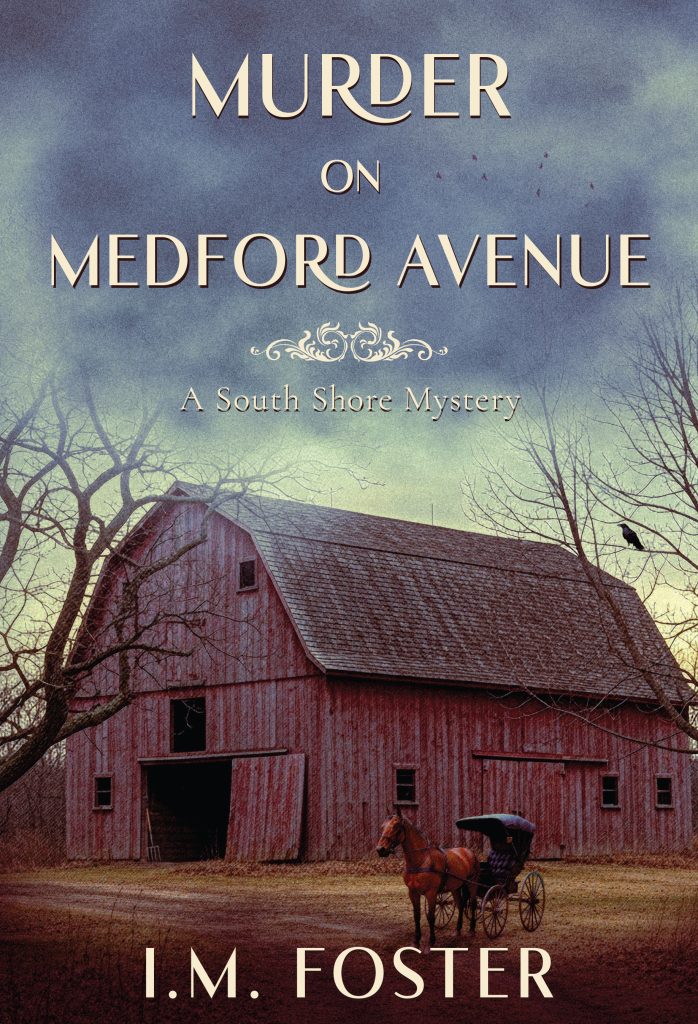
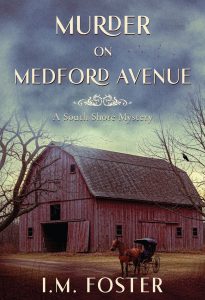
Murder on Medford Avenue is the fourth book in the South Shore Mystery series, set in a peaceful village on Long Island’s South Shore at the turn of the 20th century. When a stranger is found murdered in a local barn, a coroner’s assistant joins forces with his librarian fiancée to solve the case, placing both his life and his fiancée’s in danger. But where does he start when the answers lie in a series of events that started years before? Themes of truth, honor, betrayal, and the pursuit of justice are woven into the narrative, both in the actions of the protagonists and, in a more sinister manner, those of the antagonist.
What inspired you to write historical fiction?
I’ve always had a love for history, as well as a passion for writing and research, which led to a bachelor’s degree in history and a master’s in library science. I find a certain romance in the past, in the times my ancestors lived, and in the legacies they left behind. Searching through history for little tidbits was like following a mystery, gathering clues, and unveiling the culprit, so the natural outcome was a love for historical mysteries. I like to think of my South Shore Mystery series as a good old-fashioned whodunnit, seasoned with history and a dash of romance.
How is this novel different than your other works?
All my works are heavily immersed in history; however, the South Shore series centers around the mystery, with just a touch of romance. I write these under the pen name I. M. Foster, while my historical romance series, Thunder on the Moor and Cross of Ciarán, are written under the pseudonym Andrea Matthews and center more on the romantic aspects of the story. The time period and location for each series is different as well. The mysteries are set at the turn of the 20th century in a small Long Island village. The romances both contain an aspect of time travel and take place on the 16th-century Anglo-Scottish Borders, in 5th-century Ireland, and in 1960s New York.
Was there a specific historical event that the book centers around? Briefly share your research journey for this story.
Rather than a specific historical event, the books are set in a specific period in history: turn-of-the-century Long Island. With a loose outline of the story in hand, I began my research by consulting the historical records at the Patchogue-Medford Library. That included everything from village directories to local newspapers. After that, I did a general study of the period. Finally, I melded it all together, fitting the characters into the period and flavoring the novel with historical tidbits that will help the reader become immersed in the book and the period it’s set in.
Character building is important even if there is truth in a story. How do you build your characters? What was the most challenging for you in building your characters?
While it’s imperative that I root my characters in their time period, I realize that I need to make them relatable to the reader of today. That’s a fine line to walk, but fortunately, I’ve discovered that human emotions remain much the same throughout history. The hardest part is knowing where to draw that line. I want to make my protagonists lovable but flawed. After all, no real person is perfect, so my characters shouldn’t be either.
How do you think the reader will connect with Daniel O’Halleran and Kathleen Brissedon in this book? Do you most connect with Kathleen on a personal level since she is a librarian also?
Actually, that is exactly why I made Kathleen a librarian. I like to think that if I were alive in that period, I might be friends with her. She’s a strong woman, and yet retains her femininity. While staunchly loyal and loving, she’s a bit mischievous, though she’ll never do anything to harm her relationship with Daniel. On the other hand, I also connect with Daniel. He is the type of man I would find attractive, and I love writing his story. It gives him a vulnerability that adds to his attraction. In a way, it’s their faults as much as their good qualities that I think will make it so easy for a reader to connect with both of them.
What inspired you to write this story? Did your life experiences add any value to writing it?
As a librarian and historian, a love of research is in my DNA. I love following a trail to find the information I’m searching for and documenting solid sources to back it up. Not so different from a detective. In a way, my education did prepare me for writing mysteries, a genre I have always loved, along with history, of course.
What is the key message or take-away that you want readers to get from reading Murder on Medford Avenue?
At the end of each novel, I hope the reader can close the book and sit back with a satisfied smile, having found a pleasant hideaway from the real world, where they can join the characters in their exploits and forget about the trials and tribulations of everyday life, if only for a while. Of course, the historian in me would also like to see my narrative spur them to find out more about the turn of the century and the real characters who may appear here and there on the pages.
Every writer has their own habits. What are yours? Do you write every day and how do you handle writer’s block?
Fortunately, I’ve yet to experience a true writer’s block. I write every day, whether on my current work or one slated for a future release. Even when I’m doing everyday tasks, I often daydream, mulling over what might happen in any given story.
Research is also an important part of my day. Even after the initial in-depth research, I find myself jumping down yet another research rabbit hole to check out something I’ve missed.
Alas, I’ve also discovered that promotion is a very real part of writing, so I do try to put aside some time for that each day.
Share something with us that you learned while writing this book.
Because my protagonist is a coroner, I’ve discovered quite a bit about the types of investigative tools and medical care that were available in 1905. It was amazing to discover how the seeds of forensic and medical science were already sprouting: the discovery of blood types, fingerprints, and even the concept of trace evidence. I love finding unique discoveries that were just beginning to peek over the horizon and incorporating them into my novels.
 What advice would you give to other aspiring historical writers?
First and foremost, do your research. There is nothing worse for a reader of historical novels, no matter what the subgenre, than to discover a glaring anachronism. After that, I would urge them to write a compelling story and stop making excuses for not publishing it. And lastly, remember that not everyone will love your book, no matter how good it is. That’s just life. Write for all those who do.
What is the last great book you read? Why?
The last book I read was Murder in Rose Hill, the final book in one of my favorite mystery series—the Gaslight Mysteries by Victoria Thompson. Sadly, she passed away last year, and I don’t believe anyone will be carrying on with the series. I loved the chemistry between her hero and heroine, the time period, and the undercurrent of romantic tension, as well as the fantastic mysteries. I’ll truly miss her writing.

HNS Sponsored Author Interviews are paid for by authors or their publishers. Interviews are commissioned by HNS.