Launch: Kerry Blaisdell’s A Lamentation of Swans
INTERVIEW BY MALLY BECKER
Kerry Blaisdell writes bestselling and award-winning Fantasy, Romance, and Mystery, including the acclaimed Dead Series, recommended for fans of TV shows like Supernatural. She’s a Pacific Northwest native, currently living in Oregon with her family, assorted animals, and more hot pepper plants than anyone could reasonably consume.
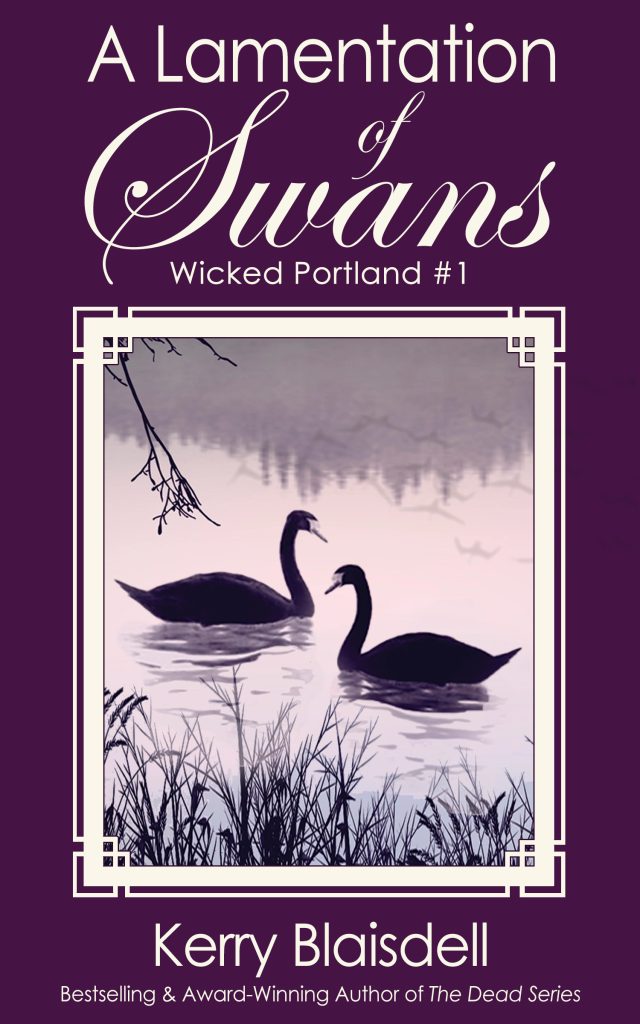
 How would you describe A Lamentation of Swans and its themes?
In a city where secrets run deeper than the Willamette, a woman fighting to save her husband is forced to build an unlikely community bound by loyalty, courage, and the desperate need to belong.
What inspired you to write about early 20th-century Portland, Oregon?
I was teaching US History to eighth-graders one year, and I encountered the story of Lola Baldwin, the first official policewoman in the United States, right here in Portland. I became fascinated with her, and from there, with the time period and constraints in which she worked. She was both ahead of her time and also part of it, and I wanted to explore that.
Who is your favorite minor/secondary character?
I really love Hua Shui. She’s had a brutal life, and yet she’s an iron rod, unbreakable in spirit, humor, and her own self-worth and dignity. I also know a secret about her, a teaser for the next book. Miller, the crusty dockworker who bails Lucky out of jail and later meets Hua Shui—well, he never forgets her, and…stay tuned…
Your historical mystery touches on society’s inhumane treatment of people with Alzheimer’s disease in the early 20th century. What drove you to incorporate that issue in your story?
This one’s very personal for me. My father was a brilliant mathematician who became a computer programmer before that was even a “thing,” and degrees in Computer Science didn’t exist. (He had a B.A. in Zoology and dropped out of grad school in his first term.) He published in math journals and attended conferences around the world. He also translated the works of Edward Waring, just as Allen Grey does in the book. And, like Allen, he developed early onset dementia. He was diagnosed at 50 and died when he was 60.
Also, living in Oregon, I knew One Flew Over the Cuckoo’s Nest was set at the Oregon Insane Asylum, and I worked for years at Oregon Health & Science University, which had historical ties to the asylum. I wanted to weave that into the story, and then Solace let me know that her biggest fear was Allen being labeled a criminal and sent to a hell worse than death.
A Lamentation of Swans includes actual figures, like early 20th-century reformer Lola Baldwin. How did you bring these characters to life?
I tried very hard to accurately represent any real people in the book, at least as far as their publicly recorded actions, words, and personalities go. I scoured what records I could find, so that, hopefully, their motivations would ring true, even though I (obviously) had to make up their conversations and personal interactions in the story.
As for why I included them, it’s because I wanted to examine the real Portland of that time period. It offers constraints, and conflicts, and surprises that simply wouldn’t be in the book if I could just make everything up. Even in my fantasy series, when the characters visit real places, I try to be as accurate as possible.
Many writers pick one genre and stick to it. You’ve already won awards for your romance and fantasy novels. What inspired you to take on the new challenge of writing historical fiction?
I know—I’m crazy, right? (LOL!) But in fact, I’ve always loved history—one of the first books I ever started was set in early Christian Wales. My degree is in Comparative Literature (French and Medieval English), so I read a lot of Dark Ages Arthurian myths. All of that ancient history also shows up in my fantasy series, so really, I’m writing about the same themes, just in different genres.
I’ve also always loved historical mysteries. The Brother Cadfael books, the Mistress of the Art of Death series, and the Sister Fidelma books are some of my favorites. Also, I get bored doing the same thing over and over, so there’s that!
What’s the hardest part of writing a series? What’s the easiest part?
Ooh—good question. For my fantasy series, the hardest part was keeping track of who knew what when. (Even with that series, there are mystery elements to it!) Or making sure the “supernatural” aspects remained consistent.
With this series, I’m only two books in, so I’m not sure what will be the most difficult. For Lucky and Solace, the challenge will be to maintain the romantic tension without making readers’ eyes roll. I’m thinking of a mystery series with an ongoing love triangle, where by now I want to yell at the heroine, “Just choose already!”
For the mystery side of it, I already have several ideas for future plots. But the challenge will still be to keep it fresh and interesting. I want Lucky and Solace both to grow as “amateur detectives,” and I want to show Lola’s evolution from a “social hygienist” to actually taking the police exam. But I don’t want to rush anything. So finding that balance will be difficult.
 What is the best writing advice you have to share with new historical fiction writers?
Do your research. Fans of historical fiction are especially rabid, and if a writer includes anything anachronistic, readers will pounce on it. An author I know only online recently excoriated a second author, who included a particular place in England in her novel, which was set at a time when the first author believed that place didn’t yet exist. She publicly called the author out and said she wouldn’t read her books anymore. So, if an author can’t verify a historical fact, I would either leave it out or have a foreword stating that “liberties” were taken with the facts to make the story work.
What’s the last great book you read?
A Court of Thorns and Roses by Sarah J. Maas.